

Why Your E-commerce Business Needs a Google Ads Audit Right Now

An Ecommerce Google Ads audit is a systematic review of your account to identify wasted spend, fix tracking issues, and uncover growth opportunities that directly impact your bottom line. Here’s what a proper audit should cover:
- Conversion tracking accuracy – Verify your data is reliable and complete
- Wasted ad spend – Identify search terms and placements draining your budget
- Campaign structure – Ensure proper organization for Brand vs. Non-Brand targeting
- Bid strategy alignment – Match your bidding approach to business goals
- Shopping & Performance Max – Audit product feeds and Merchant Center health
- Landing page performance – Evaluate conversion rates and user experience
Research shows that significant inefficiencies (often around 20%) are common in Google Ads accounts. Even worse, approximately 60% of ad spend typically goes toward search terms that never convert. For e-commerce businesses, this represents thousands or even hundreds of thousands of dollars in wasted budget every year.
If you’ve ever stared at your Google Ads dashboard wondering “Why is this happening?”—you’re not alone. Most businesses waste around 76% of their ad spend without realizing it. The good news? A focused audit can uncover these leaks fast.
I’m Lior Krolewicz, an ex-Special Ops commander turned Google Ads expert with 15 years of experience optimizing e-commerce campaigns and conducting Ecommerce Google Ads audits that have saved clients millions in wasted spend. I’ve built proprietary systems that systematically identify performance issues across every campaign variable, ensuring nothing gets missed.

The Foundation: Tracking Accuracy and Account Structure
Before we dive into the weeds of keywords and bids, we must ensure the foundation of your account is solid. If your data is wrong, every decision you make based on that data will be wrong. It’s like trying to steer the streets of New York with a map of Los Angeles—you’re going to get lost, and it’s going to be expensive.
First, we check your conversion tracking. This is the most critical step. Shockingly, research indicates that only 57.7% of Google Ads accounts have some level of conversion tracking, and of those, only half are tracking anything meaningful. We need to verify that your conversion tags are firing correctly and that you aren’t double-counting sales. We also recommend ensuring Google Analytics 4 (GA4) is Google’s new measurement solution is fully integrated and linked.
Next, we look at your account hierarchy and naming conventions. A messy account is a sign of a messy strategy. We use a logical naming convention that identifies the campaign type, objective, and product line. This makes How to Audit Your Google Ads Account a much faster process.
Finally, we evaluate your attribution modeling. Most advertisers stick with the default model without understanding how it impacts their data. We need to know What Are Attribution Models In Google Adwords to properly credit the touchpoints that lead to a sale. When a customer might click an ad on their phone in Manhattan but buy on their laptop in an office later, accurate attribution is key.
Executing a Comprehensive Ecommerce Google Ads audit
Now that the foundation is set, it’s time to look at the money. The goal of an Ecommerce Google Ads audit is to maximize profit, not just clicks. We start by setting up a “Master View” in your Google Ads interface.
We focus on specific columns that tell the real story:
- Daily Budget & Spend
- Conversions & Conversion Rate
- Revenue & ROAS (Return on Ad Spend)
- Search Impression Share (Lost to Rank vs. Lost to Budget)
We need to define your Break-even ROAS (the point where you stop losing money) and your Goal ROAS (where you actually make a profit). If a campaign is performing below break-even, it’s a “lemon” that needs immediate attention. If it’s above goal, it’s a “gem” that might deserve more budget. Knowing What Google Adwords Metrics Should I Be Looking At allows us to distinguish between noise and actual performance signals.
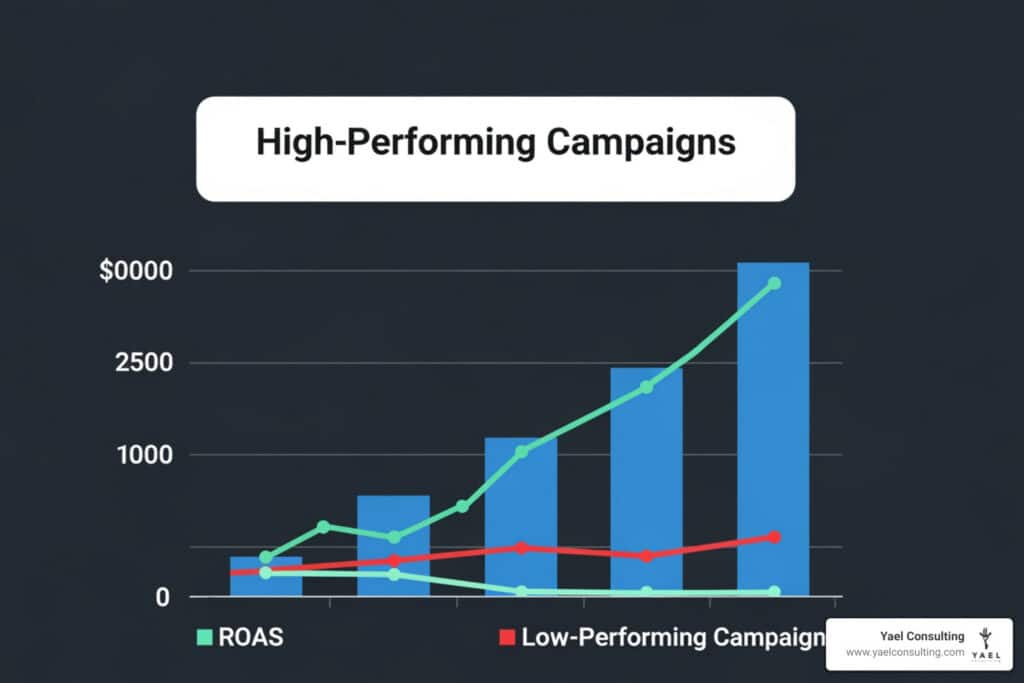
When analyzing your budget, we ask: Is It Time To Increase Your Adwords Budget? We look for campaigns limited by budget that have high ROAS—these are your biggest missed opportunities for profit growth.
Identifying and Eliminating Wasted Ad Spend
Wasted spend is the “silent killer” of e-commerce profitability. Research shows that across accounts with decent tracking, a staggering 60.73% of ad spend goes toward search terms that never convert. We use the Search Terms Report to hunt down these budget leaks.
The primary weapon here is the negative keyword. By using Google Ads Negative Keywords, we prevent your ads from showing up for irrelevant queries. For example, if you sell “premium leather boots,” you don’t want to pay for clicks from people searching for “cheap rubber boots” or “how to clean boots.”
We also watch out for broad match pitfalls. While Google pushes broad match for scalability, it often leads to “search term cannibalization” where your ads show up for vaguely related (but unprofitable) terms. We apply Expert Tips For Adding Negative Keywords to ensure your budget is protected.
Aligning Bid Strategies with Business Goals
Google offers a buffet of bidding strategies, but not all of them belong on your plate. We evaluate whether you are using Smart Bidding (like Target ROAS or Target CPA) or Manual CPC.
For most established e-commerce accounts, Target ROAS is the gold standard because it aligns directly with revenue goals. However, these AI-driven strategies need data to work—usually at least 30-50 conversions per month per campaign. We dive into The Art And Science Of How To Bid On Google Adwords to determine if your current strategy is helping or hurting.
We also look for:
- Portfolio Bidding Strategies: Grouping campaigns to give the AI more data.
- Seasonality Adjustments: Telling Google to expect a spike during Black Friday or a dip in the post-holiday lull.
- Bid Caps: Ensuring the “machine” doesn’t pay $50 for a click on a $20 product.
Choosing the Cpa Cpc Cpm Best Adwords Bidding Solution depends entirely on your specific business margins and volume.
Optimizing Search Campaigns: Keywords and Ad Creative
Search campaigns are the bread and butter of intent-based marketing. When someone types a query into Google, they are telling you exactly what they want. Your job is to show them you have it.
The “litmus test” for search performance is the Quality Score. It’s a 1-10 rating of how relevant your ad and landing page are to a keyword. As we know, Quality score and ad rank are important metrics; a high score leads to lower costs-per-click and better ad positions.
We also focus on CTR (Click-Through Rate) optimization. If people see your ad but don’t click, Google thinks you aren’t relevant and will charge you more. We look at How To Improve Ctr Google Adwords by testing headlines and using every available ad extension (Sitelinks, Callouts, etc.).
Refining Keywords in an Ecommerce Google Ads audit
Keyword selection is about finding the “goldilocks” zone—not too broad, not too specific. We analyze your match types to ensure you have the right balance. We often see accounts relying too heavily on broad match, which we call a “dead giveaway” of an unmanaged account.
We look for Different Match Types In Google Adwords Explained to see if we can move high-performing search terms into their own Exact Match ad groups. We also hunt for long-tail opportunities—specific 3-4 word phrases that have lower competition and higher intent.
A common debate is: Should We Stop Bidding On Brand For Adwords? Generally, we recommend bidding on your own brand to protect your “digital storefront” from competitors, but we must ensure these campaigns aren’t just cannibalizing organic traffic that you would have gotten for free anyway. Using A Ppc Consultant Tips For Keyword Research helps us find that balance.
Auditing Ad Copy and Creative Relevance
With the sunsetting of Expanded Text Ads, Responsive Search Ads (RSAs) are now the standard. Google takes your headlines and descriptions and mixes them to find the best combination. But “garbage in, garbage out” still applies.
We check your Ad Strength ratings and look for:
- Clear Value Propositions: Why should they buy from you?
- Strong Calls to Action (CTAs): “Shop Now,” “Get 20% Off,” or “Free Shipping.”
- Dynamic Keyword Insertion: Making the ad copy match the user’s search exactly.
Our Ad Copy Tips From A Google Adwords Consultant emphasize that your ads should tell a cohesive story. If you’re struggling with what to write, we provide guidance on How To Write Effective Ad Copy On Google Adwords that resonates with your specific audience.
Auditing Shopping and Performance Max Campaigns
For e-commerce, Google Shopping is often the biggest revenue driver. It’s also where most of the technical errors happen. An audit isn’t complete without a deep dive into the Google Merchant Center (GMC).
We start with Google Merchant Center Best Practices to ensure your feed is healthy. If your products are disapproved, they aren’t showing up, and you’re losing money. We’ve seen cases where Google Merchant Center Disapprovals World Wide Again wiped out a client’s revenue overnight because of a simple feed error.
| Feature | Standard Shopping | Performance Max |
|---|---|---|
| Control | High (Manual bids, Negative keywords) | Low (AI-driven, Automated) |
| Placement | Shopping Tab, Search Results | Search, YouTube, Display, Gmail, Maps |
| Setup | Product Feed + Campaign | Product Feed + Creative Assets + Audience Signals |
| Best For | Granular control over specific SKUs | Scaling across the entire Google ecosystem |
When following Best Practices For Setting Up A Shopping Campaign, we use custom labels to segment products by margin, seasonality, or performance (e.g., “Top Sellers” vs. “Clearance”).
Maximizing Performance Max in your Ecommerce Google Ads audit
Performance Max (PMax) is Google’s “black box” campaign type. It’s powerful, but it can be incredibly opaque. During an Ecommerce Google Ads audit, we use scripts to see where your money is actually going.
There’s a free version of the script linked here that allows us to see the spend allocation across Shopping, Search, Display, and Video. If PMax is spending 50% of your budget on junk Display placements that don’t convert, we need to know.
We also audit your audience signals. Are you feeding the machine the right data? We look at 5 Ways Scale Adwords Accounts Using Conversion Data to ensure your PMax campaigns are targeting your ideal customers, not just chasing cheap, low-intent traffic.
Improving Product Feed Quality and Merchant Center Health
Your product feed is the heartbeat of your Shopping campaigns. If the data is poor, the ads will be poor. We check for GTIN accuracy, as missing barcodes can severely limit your reach.
We also look at Product Titles. Are they optimized with the keywords people actually search for? For example, “Blue Summer Dress” is okay, but “Women’s Floral Blue Summer Dress – V-Neck Cotton – Size M” is much better. We also consider Seo Image Optimization How To Get Your Images Seen within the feed—high-quality, clear images always win the click.
Finally, we check if Do Crawl Errors Affect Google Ads. If Google can’t crawl your site to verify prices or availability, they will disapprove your items.
Evaluating Landing Page Performance and Competitor Insights
You can have the best ads in the world, but if your website is a disaster, you won’t make a dime. Landing pages are external to Google Ads, but they have a massive impact on your performance.
We evaluate:
- Mobile Speed: Does the page load in under 3 seconds?
- Relevance: Does the page match the ad’s promise?
- Clarity: Is the CTA (Call to Action) obvious?
Using The Best 2 Tips On How To Optimize Your Landing Page and 3 Ways To Optimize Your Conversion Rate Strategy, we look for friction points that cause users to bounce. We also verify What Is Responsive Design And Why Its Important For Seo and PPC alike—your site must work perfectly on every device.
Finally, we look at Auction Insights. This is our “Spy vs. Spy” moment where we see who is outranking you and why. By Spy Vs Spy Unmasking Your Google Ads Rivals, we can adjust our strategy to beat the competition on the most valuable terms.
Frequently Asked Questions about E-commerce Audits
How often should e-commerce businesses conduct a Google Ads audit?
We recommend a deep-dive audit at least once a quarter. However, a weekly “health check” is essential for high-volume accounts to catch sudden disapprovals or budget spikes. Think of it like car maintenance—an oil change every few months keeps the engine from exploding.
What are the most common signs that an audit is needed?
The biggest red flag is a rising CPA (Cost Per Acquisition) accompanied by a falling ROAS. Other signs include a drop in impression share, a sudden spike in “junk” search terms, or if you haven’t touched your campaign settings in over six months. If your account is on “autopilot,” you’re likely overspending.
What are the biggest mistakes to avoid during an audit?
The biggest mistake is making too many changes at once. If you change your bids, your keywords, and your ad copy all in the same day, you won’t know which change caused the result. Another common error is relying on Google’s “Optimization Score”—most of those suggestions are designed to make Google more money, not you.
Conclusion
Conducting a thorough Ecommerce Google Ads audit isn’t just about clicking buttons in an interface; it’s about building a strategic roadmap for your business. By systematically eliminating waste and doubling down on what works, you can transform a struggling account into a profit machine.
At Yael Consulting, we’ve spent over 15 years refining this blueprint. We know that Ecommerce PPC Your Secret Weapon for Online Retail Success requires a blend of proprietary technology and human expertise. Whether you are based in New York, Los Angeles, or anywhere else in the USA or Israel, our goal is the same: profit maximization.
If you’re ready to stop guessing and start growing, we invite you to explore our Adwords Management Services. We offer a free, actionable 15-minute Google Ads analysis that will show you exactly where your budget is leaking and how to fix it. Let’s get to work.