

Why Your Google Ads Might Be Bleeding Money Right Now

Increase ad conversions with these proven strategies:
- Track conversions accurately using Google Ads conversion tracking and improved conversions
- Use specific keywords with high purchase intent (e.g., product model numbers vs. generic terms)
- Add negative keywords to filter out irrelevant traffic (like “free” if you’re selling products)
- Optimize landing pages for speed and mobile—every 1-second delay costs you 7% of conversions
- Test ad copy variations including prices to pre-qualify clicks
- Implement Smart Bidding like Target CPA or ROAS once tracking is in place
- Review your search terms report weekly to refine keyword targeting
You’re spending money on ads. You’re getting clicks. Your phone might even be ringing or your website traffic is up.
But here’s the problem: those clicks aren’t turning into customers.
If this sounds familiar, you’re not alone. WordStream’s 2022 benchmarks show average conversion rates declined across nearly every industry except Arts & Entertainment. More businesses are spending more money while converting fewer visitors.
The culprit? A combination of changing consumer behavior, Google’s aggressive automation push, and the widening gap between ad click and actual purchase.
Think about it: consumers now research products across 5-7 touchpoints before buying. They compare prices on 3+ sites. They read reviews, watch unboxing videos, and check your competitors before making a decision. Meanwhile, Google’s broadened match types and Performance Max campaigns are sending you more traffic—but not necessarily better traffic.
The good news? You don’t need more traffic to make more money. You need to convert the traffic you already have.
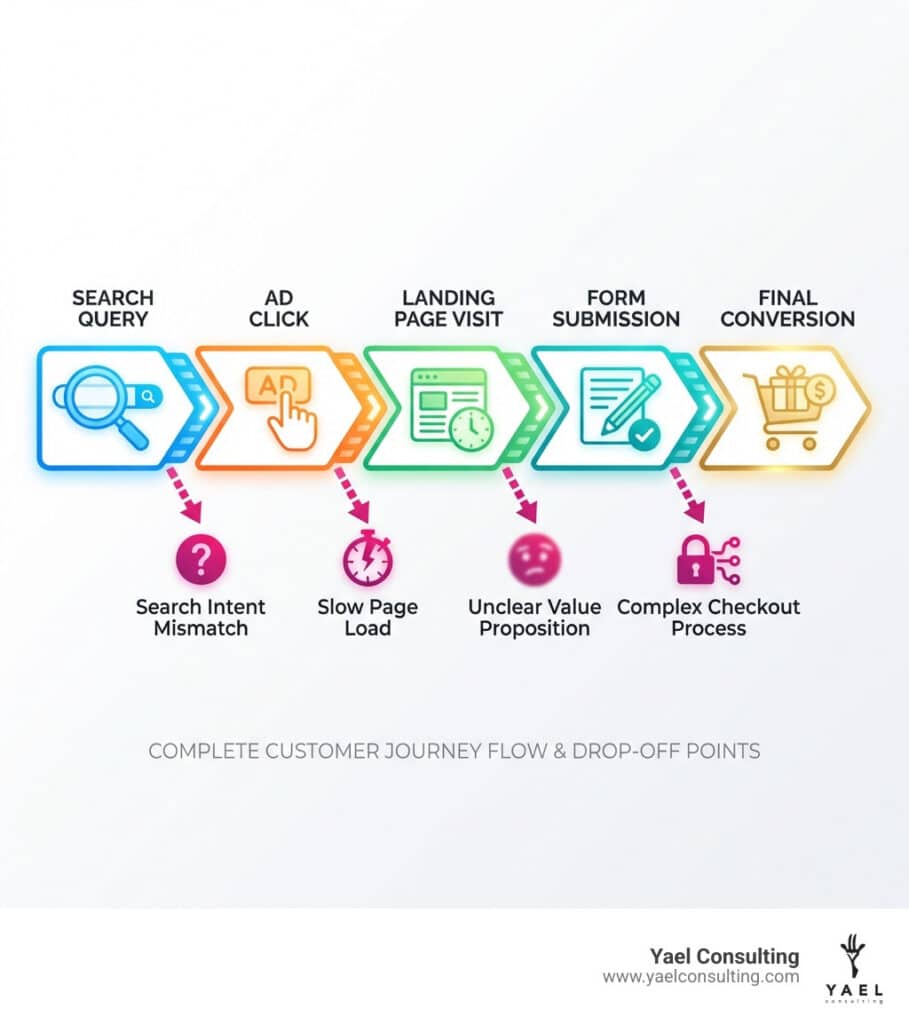
This isn’t about tweaking button colors or running endless A/B tests. It’s about understanding why people click your ads but don’t buy, then systematically removing those obstacles. From keyword intent to landing page friction to checkout abandonment, every step in your funnel either builds trust or bleeds conversions.
I’m Lior Krolewicz, a former Special Operations commander turned Google Ads expert who has helped companies direct millions in ad spend to increase ad conversions and profitability. Over 15 years, I’ve built a proprietary system that diagnoses conversion leaks like a digital medic—identifying exactly where your funnel breaks and how to fix it fast.
Relevant articles related to Increase ad conversions:
Diagnosing the Decline: Why Average Conversion Rates Are Dropping
We have entered an era where “more clicks” often translates to “more waste.” The global average e-commerce conversion rate hovers around 3.68%, but many industries are struggling to hit even half of that. Why?
First, consumer research behavior has fundamentally shifted. People spend more time in the “messy middle” of the buying journey. They aren’t just clicking the first ad and buying; they are gathering data. This means your ad might be the first touchpoint, but without a strategy to increase ad conversions later in the funnel, you’re just paying for your competitor’s market research.
Second, Google has made significant changes to its platform. The shift toward broadened match types means your ads show up for searches that are “related” but don’t always have high commercial intent. When you combine this with limited search term visibility, you have a recipe for spending money on traffic you can’t even see.
Furthermore, Performance Max (PMax) automation can be a double-edged sword. While it uses AI to find customers, it often prioritizes volume over value if not properly steered. To combat this, we must look at 3 Ways to Optimize Your Conversion Rate Strategy to regain control. Understanding industry conversion benchmarks is the first step in knowing if your “declining” rate is a platform issue or a fixable internal leak.
Core Strategies to Increase Ad Conversions in Google Ads
To win in the current landscape, we need to go back to the basics of intent. Not all clicks are created equal.
Keyword Intent Prioritization
If you want to increase ad conversions, you must prioritize keywords that signal a readiness to buy. For example, someone searching for “Acme 710c printer” is much closer to a purchase than someone searching for “best printers.” The more specific the search, the higher the conversion rate. While specific keywords have lower search volume, their ROI is significantly higher.
The Power of Negative Keywords
One of the fastest ways to improve your results is to stop paying for people who will never buy. Adding negative keywords like “free,” “jobs,” or “manual” ensures your budget is reserved for paying customers. We’ve seen accounts transform overnight just by implementing these Expert Tips for Adding Negative Keywords.
The Search Terms Report
We recommend reviewing your search terms report weekly. This report shows you exactly what people typed before clicking your ad. Did they search for “video game magazine” when you sell “video game figurines”? If so, add “magazine” as a negative. This constant refinement is the heartbeat of a healthy account.
Leveraging Automation and Smart Bidding to Increase Ad Conversions
Google’s AI is powerful, but it needs good data to work. Smart Bidding strategies like Target CPA (Cost Per Acquisition) and Target ROAS (Return on Ad Spend) allow the system to bid more aggressively when a conversion is likely.
However, AI is only as good as the feedback loop you provide. This is where enhanced conversions measurement comes in. By using hashed, first-party data, improved conversions help Google “see” conversions that might have been lost due to cookie restrictions or cross-device behavior. Businesses that leverage data-driven marketing are six times more likely to be profitable year-over-year.
Refining Ad Copy and Pricing to Increase Ad Conversions
Your ad copy is your first filter. If you want to increase ad conversions, stop trying to get everyone to click. Use your copy to pre-qualify your visitors.
- Price Inclusion: Including prices in your ad text can deter “window shoppers” who aren’t comfortable with your price point, saving you money on unqualified clicks.
- Responsive Search Ads (RSAs): Use all 15 headlines and 4 descriptions. Let Google’s machine learning test combinations to find what resonates best.
- Ad Rotation: Always test at least two variations. Does “Free Shipping” convert better than “10% Off”? You won’t know until you test.
For deeper insights, check out our guide on How to Write Effective Ad Copy on Google AdWords and these Ad Copy Tips From a Google AdWords Consultant.
Optimizing the Post-Click Experience: Landing Pages and UX
You can have the perfect ad, but if your landing page is a mess, your conversion rate will suffer. We often see businesses spend $10,000 on ads and $0 on the page those ads lead to. This is a mistake.
The Need for Speed
Statistics show that even a one-second delay in page load time can cause a 7% drop in conversions. In mobile browsing, speed is not a luxury; it’s a requirement. If your page takes more than 3 seconds to load, you are essentially throwing 20-30% of your ad spend in the trash. You can see the impact of page delays on conversions in real-time through your bounce rates.
Mobile-First Design
With over 79% of users (especially on platforms like Facebook) accessing content via mobile, your design must be mobile-first. This means large buttons, easy-to-read text, and no intrusive pop-ups that block the entire screen.
Clarity Over Persuasion
As Paul Graham once suggested, explain your product as if you were talking to a close friend. Avoid jargon. A clear value proposition should tell the visitor exactly what you offer and why they should care within 8 seconds. If they can’t figure out what you do, they will leave. Our framework for Creating Landing Pages That Convert focuses on this “clarity first” approach.
Reducing Friction with Multi-Step Forms and Seamless Checkout
Friction is the enemy of conversion. Every extra field in a form increases the chance of abandonment.
- Multi-Step Forms: For complex services, use multi-step forms. Breaking a long process into smaller, “bite-sized” pieces makes it feel less overwhelming.
- Guest Checkout: Never force a user to create an account before buying. The famous “300 million dollar button” story proves that allowing guest checkout can skyrocket revenue.
- The Breadcrumb Technique: Paradoxically, sometimes asking more questions in a smart way (starting with easy, non-threatening ones) can build enough momentum to double your conversions.
Explore more on this in our 4 Ways to Improve Your Landing Page Conversion Rate.
Data-Driven Growth: A/B Testing and Technical Optimization
To truly increase ad conversions, we must move from “guessing” to “knowing.” This requires structured testing.
Statistical Significance
Don’t turn off an ad or change a landing page because of one bad day. You need enough data to reach statistical significance. Tools like Google Analytics 4 and heatmapping software (like CrazyEgg or VWO) can show you where people are getting stuck.
Qualitative vs. Quantitative Data
Quantitative data (Google Analytics) tells you what is happening (e.g., people are bouncing from the pricing page). Qualitative data (user recordings or surveys) tells you why (e.g., “I couldn’t find the shipping costs”). Combining these two is the secret sauce of Conversion Rate Optimization (CRO). Learn How to Set Up Effective A/B Tests at the Ad Copy Level to start your journey.
Advanced Tracking with Meta Pixel and Conversions API for DTC Brands
For Direct-to-Consumer (DTC) brands, Facebook (Meta) remains a powerhouse. However, the old way of just using a Pixel is no longer enough.
Integrating the Conversions API (CAPI) with the Meta Pixel is essential. The US apparel brand Love Your Melon saw a 17% increase in attributed revenue simply by making this technical integration. This allows for better tracking in a post-iOS 14 world.
Building a Facebook Sales Funnel
Don’t just run “Buy Now” ads to strangers. Build a funnel:
- TOFU (Top of Funnel): Awareness ads using video to introduce the brand.
- MOFU (Middle of Funnel): Retargeting those who watched the video with social proof or educational content.
- BOFU (Bottom of Funnel): Conversion ads with a strong offer or urgency (e.g., “Sale ends tonight”).
By Setting Up Effective Remarketing Campaigns, we can nurture leads until they are ready to convert.
Strategic Spend Management: Balancing Budget and Profitability
There is a common myth that higher ad spend automatically leads to higher conversion rates. In reality, you often hit a point of diminishing returns.
As you scale your budget, you might start reaching “colder” audiences or bidding against yourself in saturated markets. This is why we focus on the “sweet spot” of profitability. If your Cost Per Acquisition (CPA) doubles while your conversion rate stays flat, you aren’t growing—you’re just getting less efficient.
To manage this, we use real-time bidding adjustments and predictive analytics. We look for signs of market saturation and pivot spend to more efficient channels when necessary. For a detailed breakdown of how to handle this, read our guide on 5 Ways to Scale AdWords Accounts Using Conversion Data.
Frequently Asked Questions about Ad Conversions
What is a good conversion rate for my industry?
While it varies, the global e-commerce average is around 3.68%. SaaS brands typically see 2–5% for signups, while Finance sites often perform higher at 3.1% due to high user intent. The goal shouldn’t be to hit a “magic number” but to consistently improve your own baseline.
How long does it take to see improvements in conversion rates?
Small technical fixes (like improving page speed) can show results in 2-4 weeks. Larger structural changes, like a new sales funnel or landing page redesign, typically take 2-3 months of testing and data collection to fully optimize.
Should I focus on traffic volume or conversion rate first?
Always optimize for conversions first. Scaling traffic to a “leaky bucket” (a site that doesn’t convert) is the fastest way to blow your marketing budget. Once your conversion path is proven and profitable, then you pour on the traffic.
Conclusion
At Yael Consulting, we don’t believe in “set it and forget it” advertising. We are a boutique agency with over 15 years of expertise in the USA and Israel, serving clients in major hubs like New York and Los Angeles. Our approach is different: we offer one-client-per-market exclusivity and direct CEO involvement to ensure your campaigns are always performing at their peak.
We use proprietary technology to find the hidden leaks in your funnel and Maximize your ROI with a Google Ads Consultant who understands that at the end of the day, only profit matters.
Stop guessing and start growing. We offer a free, actionable 15-minute Google Ads analysis where we’ll look under the hood of your account and show you exactly where you can increase ad conversions. No fluff, just guaranteed value. Reach out today and let’s fix your ads together.