
Why Driving Qualified Leads Is the Lifeblood of Modern Business Growth

Drive qualified leads effectively and you open up predictable revenue, sustainable growth, and higher profit margins. Here’s what you need to know:
To drive qualified leads successfully:
- Understand lead types – MQLs show interest, SQLs demonstrate buying intent, PQLs have used your product
- Optimize your funnel – Track leads from awareness (TOFU) through consideration (MOFU) to conversion (BOFU)
- Leverage Google AI – Use qualified and converted lead goals in Google Ads for Smart Bidding and Performance Max
- Create strategic content – Use LinkedIn’s Niche Problem Post formula to start conversations with decision-makers
- Qualify systematically – Apply frameworks like BANT, MEDDIC, or CHAMP to focus on high-potential prospects
- Act fast – Connect with leads within 60 seconds to increase conversion by 391%
The reality is simple: lead generation is no longer about volume. It’s about quality.
Over 80-90% of typical leads convert at less than 2%. That’s wasted ad spend, wasted sales time, and wasted opportunity. Meanwhile, paid search impressions dropped 15% year-over-year, and AI will likely reduce click volume by another 25% in the next two years.
The old playbook is broken.
Smart businesses are shifting from mass MQL generation to Product Qualified Leads (PQLs) – prospects who’ve actually experienced the product and convert at 5X higher rates. Others are using Google Ads’ new qualified and converted lead goals to optimize campaigns with offline CRM data, letting AI bid smarter on prospects who actually close.
Some companies have reduced churn by 60% just by changing their lead focus. Others generated $10,000 in pipeline from a single strategic LinkedIn post in eight days.
The common thread? They stopped chasing vanity metrics and started driving leads that actually convert into revenue.
I’m Lior Krolewicz, an ex-Special Ops commander and Google Ads expert who has helped companies direct millions in ad spend to drive qualified leads and measurable profit. Through my proprietary IBEX technology and systematic approach, I’ve helped clients improve performance by 23% on average while expanding operating margins from 22% to 41%.
Mastering the Lead Funnel and Qualification Frameworks

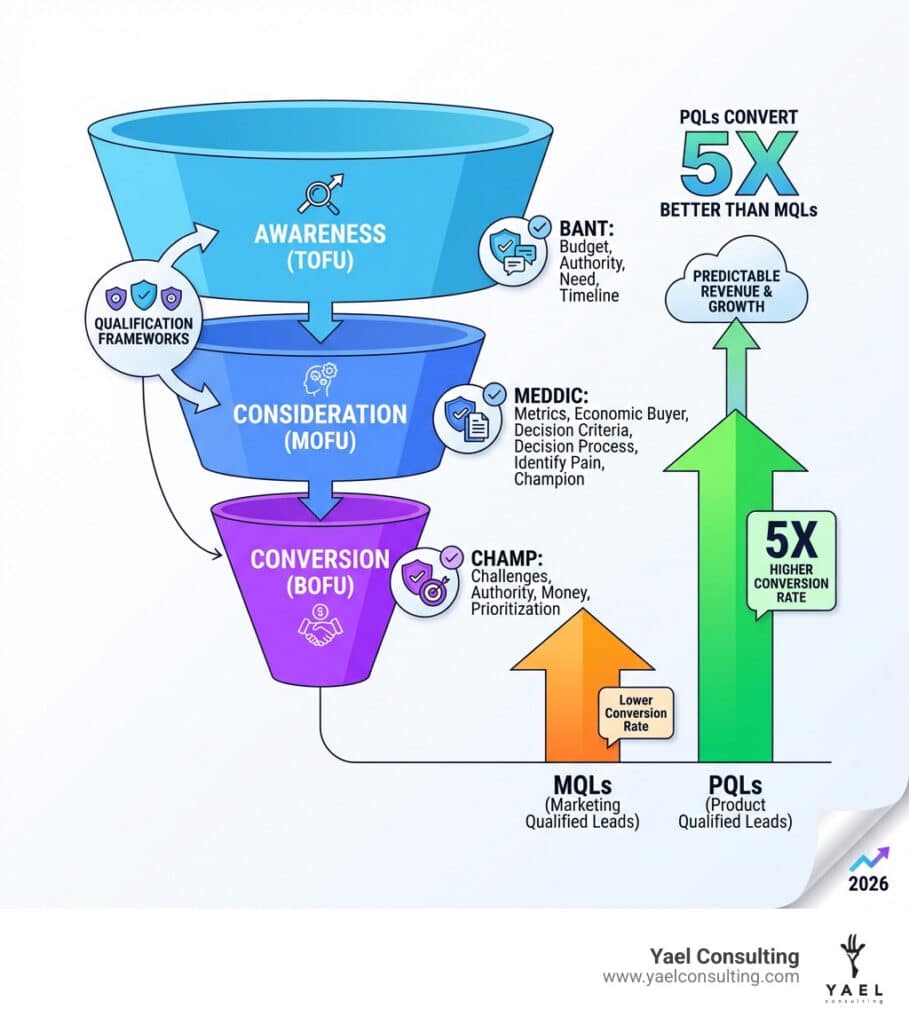
To drive qualified leads, we must first understand the journey a prospect takes. Think of your lead generation funnel as a filter, not just a bucket. We categorize this journey into three main stages:
- TOFU (Top of the Funnel): The Awareness stage. Here, people are looking for answers to specific questions. They might find your blog post or an educational video.
- MOFU (Middle of the Funnel): The Consideration stage. Prospects have defined their problem and are looking for solutions. They are downloading your ebooks or attending webinars.
- BOFU (Bottom of the Funnel): The Conversion stage. They are ready to buy or book a demo.
However, simply having people in your funnel isn’t enough. We need a systematic way to separate the “just looking” from the “ready to buy.” This is where qualification frameworks come in. You can level up your leads for professional services by applying these structured guidelines:
| Framework | Meaning | Best For |
|---|---|---|
| BANT | Budget, Authority, Need, Timeline | Traditional sales; quick assessment of financial means and urgency. |
| MEDDIC | Metrics, Economic Buyer, Decision Criteria, Decision Process, Identify Pain, Champion | Complex B2B deals; focuses on organizational dynamics and internal advocates. |
| CHAMP | Challenges, Authority, Money, Prioritization | Modern B2B; leads with the prospect’s pain points to build immediate relevance. |
| GPCTBA | Goals, Plans, Challenges, Timeline, Budget, Authority | Inbound sales; focuses on the positive implications of a solution. |
Defining MQLs vs. SQLs
In lead generation, not all leads are created equal. We distinguish between them based on their level of engagement and buying intent.
- Marketing Qualified Leads (MQLs): These are prospects who have shown interest—perhaps they subscribed to your newsletter or downloaded a checklist—but aren’t quite ready for a sales call. They fit your Ideal Client Profile (ICP) based on demographic data but need more nurturing.
- Sales Qualified Leads (SQLs): These are the “hot” leads. They’ve moved past general interest and are actively inquiring about pricing or booking a demo. They have a clear buying intent that requires immediate sales intervention.
Using a lead scoring system—assigning points for actions like visiting a pricing page or opening multiple emails—helps your team prioritize SQLs while keeping MQLs in the nurturing loop.
The Power of Product Qualified Leads (PQLs)
If you really want to drive qualified leads that stick, look at PQLs. A Product Qualified Lead is someone who has already experienced the value of your product, usually through a free trial or a freemium model.
Why are they so valuable? Because they don’t just think your product might work—they know it does. Research shows that PQLs are 5X more likely to convert than MQLs. Furthermore, focusing on PQLs can reduce customer churn by up to 60% because the user already understands the product’s fit before they ever pay a dime. This leads to shorter sales cycles and a much lighter lift for your sales team.
How to Drive Qualified Leads Using Google Ads and AI
Google Ads has evolved. We are no longer just bidding on “clicks”; we are optimizing for “results.” To help businesses drive qualified leads, Google has replaced the old “imported leads” goal with two specific categories: Qualified leads and Converted leads.
These new categories allow us to accurately identify the most promising leads using offline conversion data. By feeding your CRM data back into Google Ads, you tell the Google AI exactly which clicks turned into real business. This leverages Smart Bidding and Performance Max to find more people like your best customers.
Steps to Update Existing Lead Conversion Actions
If you are already running campaigns, you need to update your conversion actions in Google Ads to take advantage of the lead funnel report. Here is the process:
- Sign in to your Google Ads account and click the Goals icon.
- Click the Conversions drop-down and select Summary.
- Look for a notification in the center of the page that says “Update now” regarding conversion categories.
- Review the suggested updates. Google will try to guess which leads are “Qualified” (interested) and which are “Converted” (closed deal).
- Click Update to confirm.
By doing this, you can now see a “lead funnel report” that shows how many people moved from an ad interaction to a qualified status, and finally to a conversion.
Creating New Qualified Lead Actions
If you’re starting fresh or want to track a new stage of your CRM funnel, you can create new conversion actions by following these steps:
- In the Conversions Summary, click + New conversion action.
- Select Import and then choose CRMs, files, or other data sources.
- Choose whether you want to track conversions by clicks or calls.
- Select the specific goal: Qualified Lead (for someone vetted by your team) or Converted Lead (for a closed sale).
- Connect your data source (like HubSpot or Salesforce) or upload a file.
This setup is the “secret sauce” for modern lead gen. It allows Google’s AI to look past the initial form fill and optimize for the actual revenue-generating events that happen offline.
Strategic Content: Driving Qualified Leads via LinkedIn and Social Proof
LinkedIn is no longer just a place to post your resume—it’s a professional networking powerhouse. Because its entire purpose is relationship building, conversations start faster here than on any other social network. Interestingly, personal profiles receive 3-4 times more reach than company pages. People want to buy from people, not faceless brands.
To drive qualified leads on LinkedIn, we recommend using LinkedIn as a content marketing tool by focusing on “Social Selling” rather than direct pitching.
The Niche Problem Post Formula
One of the most effective ways to generate leads organically is the Niche Problem Post Formula. The goal is to spend 80% of the post identifying a specific problem and only 20% on the solution. This builds deep empathy and trust.
- The Hook: A bold statement that challenges a common belief (e.g., “Cold calling isn’t dead, but your script is”).
- Symptom Detailing: Describe exactly what the prospect is feeling (e.g., “You’re sending 100 emails a day and getting zero replies”).
- Problem Naming: Give the problem a memorable name (e.g., “The Invisible Inbox Syndrome”).
- Solution Introduction: Briefly explain how you solve it.
- Low-Commitment CTA: Ask them to comment or DM for a “15-minute case study” rather than a “hard sell” demo.
Leveraging Social Proof and Reviews
Before a lead ever books a demo, they want to know what others think. Statistics show that 92% of buyers rely on social proof before making a purchase.
We encourage our clients to implement highly effective best practices for social proof by:
- Using Video Testimonials: Seeing a real person talk about their success is incredibly persuasive.
- Highlighting Similar Roles: If a prospect is a CFO, show them a review from another CFO.
- Displaying Metrics: “We helped Company X grow” is okay. “We helped Company X increase leads by 133%” is much better.
Essential B2B Strategies to Drive Qualified Leads
In the B2B space, the buying journey is longer and more complex. 83% of the buying journey is complete before a prospect even talks to a sales rep. Therefore, your digital presence must do the heavy lifting.
- Gated Content: Offer valuable resources (whitepapers, templates, ebooks) in exchange for an email address.
- Webinars: These are fantastic for MOFU engagement. Focus on education, not selling.
- SEO Content: Attract inbound leads who are already searching for solutions.
- Retargeting: Most people won’t convert on the first visit. Use paid ads to stay top-of-mind with people who have already visited your site.
To maximize your results, try implementing these 3 easy and effective conversion boosters to ensure your website is a lead-generating machine.
Optimizing Lead Capture and Routing
Getting the lead is only half the battle; what you do next determines if they convert.
- Keep Forms Simple: Overcomplicated forms kill conversion rates. Only ask for what you absolutely need.
- Smart Routing: Use tools to assign leads to the right salesperson in real-time.
- The 60-Second Rule: Connecting with a lead within 60 seconds increases conversion chances by a staggering 391%. If you wait hours or days, they’ve already moved on to your competitor.
- Live Chat & Automated Booking: Let prospects book a demo on their schedule, not yours.
Implementing a Multi-Departmental PQL Strategy
Driving Product Qualified Leads isn’t just a marketing job—it requires total alignment across your company:
- Marketing: Tracks which channels bring in the most active trial users.
- Pre-sales: Provides automated demos to help users see value quickly.
- Sales: Focuses on converting high-usage trial users into paying customers.
- Product: Uses feedback from PQLs to improve the user experience.
- Customer Success: Identifies opportunities for upsells based on product usage patterns.
Frequently Asked Questions about Lead Generation
What is the difference between lead generation and demand generation?
Lead generation is about capturing contact information to move prospects into a sales funnel. Demand generation is broader—it’s about creating awareness and interest in your brand so that when people are ready to buy, you are the first company they think of.
Why are Product Qualified Leads (PQLs) considered more valuable?
PQLs have “hands-on” experience with your product. They’ve already seen the value, which means they have higher conversion rates (5X higher than MQLs) and lower acquisition costs. They also tend to be more satisfied customers with lower churn rates.
How does AI improve modern lead generation?
AI helps us drive qualified leads by analyzing massive amounts of data to predict which prospects are most likely to convert. It personalizes content at scale, optimizes ad bidding in real-time (like Google’s Smart Bidding), and can even automate initial nurturing through smart chatbots and personalized email sequences.
Conclusion
At Yael Consulting, we believe that every dollar of your marketing budget should be an investment in growth. As a boutique Google Ads agency with over 15 years of expertise, we don’t just chase clicks; we focus on sales and profit optimization. Our proprietary technology and direct CEO involvement ensure that your campaigns are always pushing the boundaries of what’s possible.
We offer one-client-per-market exclusivity because we believe in winning for our partners, not competing against them. If you’re ready to stop guessing and start growing, we invite you to unlock your growth with a free 15-minute Google Ads analysis from our expert consultants. We’ll dive into your account, find the wasted spend, and show you exactly how to drive qualified leads that will transform your business.