
From Good to Great: How to Optimize Your Google Ads Campaigns

Why Adwords Campaign Optimization Is Critical for Your Bottom Line
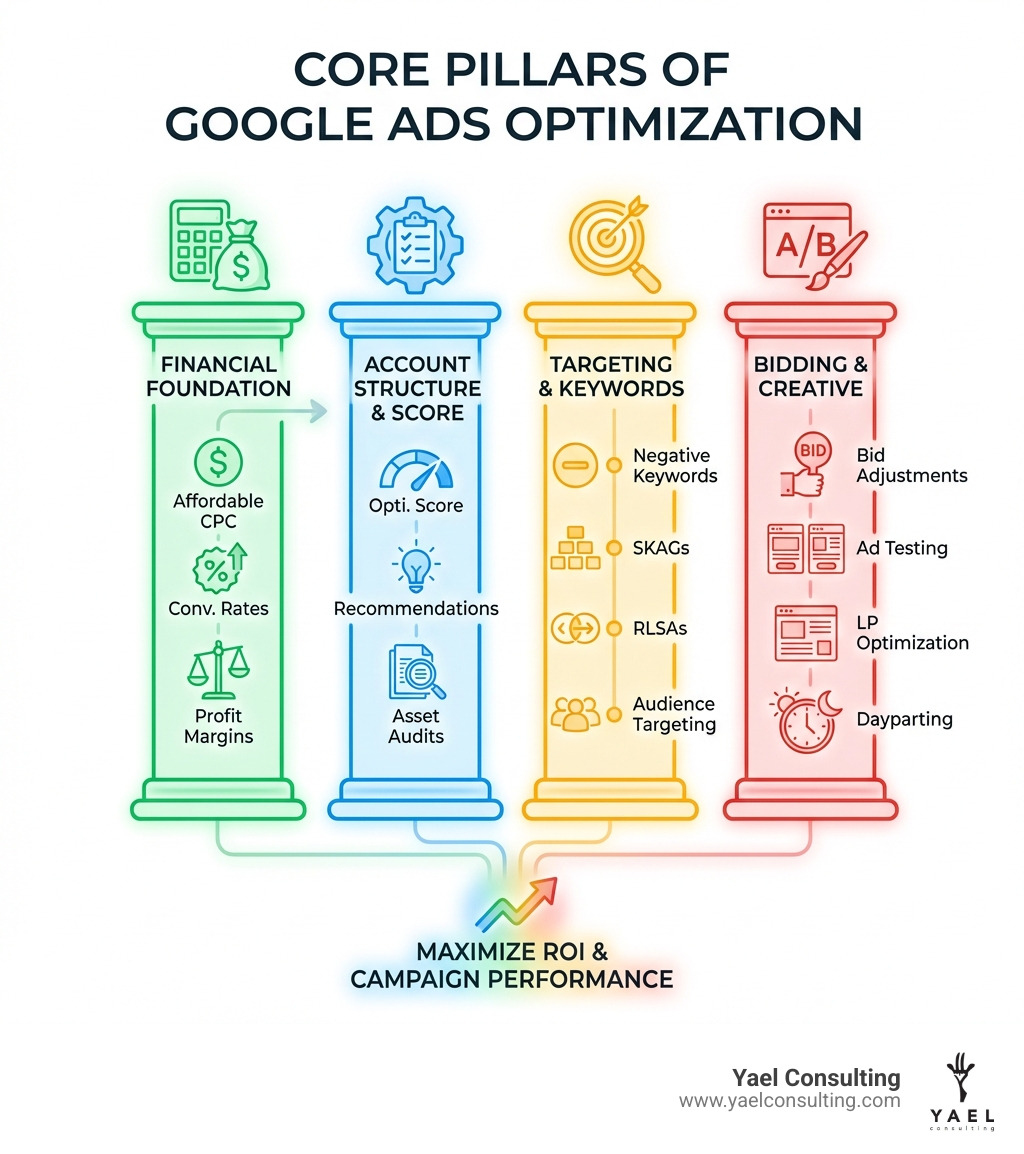
Adwords campaign optimization is the process of systematically improving your Google Ads campaigns to reduce wasted spend, increase conversions, and maximize return on investment. Here’s what you need to optimize:
- Financial Foundation – Calculate your affordable cost-per-click (CPC) based on profit margins and conversion rates
- Optimization Score – Leverage Google’s built-in recommendations to identify quick wins and improve campaign health
- Keyword Targeting – Use negative keywords, SKAGs, and RLSAs to reach qualified buyers
- Ad Copy & Landing Pages – Test variations and ensure relevance to improve Quality Score
- Bidding & Budgets – Apply bid adjustments for devices, locations, and times when conversions happen
- Regular Audits – Review performance daily, weekly, and monthly to catch issues early
Give your Google Ads campaigns room to run unchecked, and they’ll chew through your budget faster than people give up their New Year’s resolutions. In today’s uncertain economic climate, every marketing dollar must count. Yet many businesses watch their ad spend disappear without understanding why campaigns underperform or how to fix them.
The truth is that successful Google Ads campaigns don’t happen by accident. They require a strategic foundation built on solid financial metrics, ongoing tactical adjustments, and a structured optimization workflow. Without this approach, you’re essentially gambling—hoping for results rather than engineering them.
Most businesses focus on surface-level metrics like click-through rates or cost-per-click. These numbers matter, but they’re not the whole story. Accounts with higher Optimization Scores consistently delivered lower CPAs and stronger ROAS, beating sub-70 accounts by more than 180% on return. This isn’t about chasing a perfect score—it’s about systematically identifying and fixing the gaps that drain your budget.
The good news? You don’t need to overhaul everything at once. Small, strategic changes compound over time. A client halved their cost per lead and increased conversion volume by 300% by implementing Single Keyword Ad Groups. Another decreased CPA by over 72% simply by matching their call-to-action to search intent. A two-second device bid adjustment resulted in a 125% increase in desktop conversions.
This guide walks you through the complete optimization process—from establishing financial guardrails to executing tactical improvements on a daily, weekly, and monthly basis. You’ll learn which levers to pull, when to pull them, and how to measure what actually matters.
I’m Lior Krolewicz, and I’ve spent 15 years optimizing Google Ads campaigns for businesses across diverse industries, directing millions in ad spend to generate measurable profit. My approach to Adwords campaign optimization combines strategic financial discipline with systematic tactical execution—the same methodology that helped us achieve a 411% increase in client task completion and a 23% average improvement in client performance. Let’s get started.
Laying the Financial Foundation for Profitability
Before we even think about keywords or ad copy, let’s talk numbers. The most crucial factor for Google Ads success isn’t a fancy bidding strategy or a clever headline; it’s understanding your fundamental financial metrics. Without this clarity, you’re essentially spending money on ads that may never yield a profitable return. We’ve seen businesses gamble away budgets by jumping into bidding without knowing what they can truly afford.
The key financial metrics that drive profitability in Google Ads campaigns are your profit per customer, your website’s conversion rate, and your ideal profit margin. These aren’t just abstract figures; they are the bedrock upon which all successful Adwords campaign optimization is built. Understanding these allows us to determine how much we can afford to pay for each click while still ensuring a healthy profit.
Determining Your Breakeven Point
So, how much can you afford to pay per click? This question sits at the heart of profitable Google Ads. The answer is directly tied to your profit per customer. Businesses with higher revenue per customer can naturally afford higher CPCs, while those with lower revenue need to keep bids tighter to remain in the black.
First, we need to know your conversion rate from website visitors to customers. Let’s say your website brings in 100 visitors, and five of them become paying customers. That’s a 5% conversion rate. This tells us that, on average, it takes 20 clicks (100 visitors / 5 customers) to generate one sale. This metric is incredibly important for any bid strategy. If you don’t know this, you might want to check out our guide on What Google AdWords Metrics Should I Be Looking At?.
Next, calculate your profit per customer. This isn’t just the revenue; it’s the revenue minus the cost of goods sold and any direct costs associated with acquiring that customer (excluding ad spend, for now). Once you have your profit per customer and your conversion rate, you can determine your maximum affordable CPC. For example, if your profit per customer is $100 and you need 20 clicks to get one customer, then you can afford to pay up to $5 per click ($100 profit / 20 clicks). Anything above that, and you’re losing money on average. This calculation is vital for smart bidding.
Beyond Breakeven: Setting an Ideal Profit Margin
Making a profit isn’t just about breaking even; it’s about making a meaningful return on your investment. This is where your ideal profit margin comes in. Setting a target profit margin ensures that your Google Ads campaigns aren’t just covering costs but actively contributing to your business’s growth.
For instance, if you aim for a 20% profit margin, you’d adjust your maximum affordable CPC calculation to factor that in. This directly influences your target Return on Ad Spend (ROAS) or Target Cost Per Acquisition (CPA) goals if you’re using automated bidding strategies. Factoring in business overheads and other operational costs into this margin ensures sustainable growth. It’s about deciding, “Is Google AdWords really worth it?” for your business, and we think it is, especially when done right. To dive deeper into making Google Ads truly profitable, explore our article Is Google AdWords Really Worth It?.
Mastering Google’s Optimization Score & Recommendations
Google Ads provides powerful built-in tools designed to help you improve your campaigns: the Optimization Score and Recommendations. Think of these as Google’s way of giving you a compass and a map to better performance.
The Google Ads Optimization Score is a metric (0–100%) that reflects how well your campaigns align with Google’s best practices. It’s located on the Recommendations tab in your Google Ads account and updates in real-time based on changes in performance, settings, and available features. Google calculates this score by looking at various factors, including missing ad extensions or assets, budget allocation, keyword targeting, match types, audience signals, and bidding strategy alignment. Each recommendation shows the percentage increase it could bring to your score.
Why is improving this score important? Because it directly correlates with better campaign performance. Advertisers that used Google recommendations to increase their account-level optimization score by 10 points saw a median 14% increase in conversions. Accounts with higher Optimization Scores consistently delivered lower CPAs and stronger ROAS, beating sub-70 accounts by more than 180% on return. It helps you identify quick wins, prioritize impactful changes, and stay aligned with Google’s latest features. For agencies like ours, maintaining a strong Optimization Score is also essential for retaining Google Partner status, adding credibility to our expertise.

How to Strategically Use Google Ads Recommendations
While the Optimization Score is a great guide, it’s crucial not to blindly chase a 100% score by applying every recommendation. Our 15 years of experience have taught us that many top-performing accounts improved their Optimization Score not by accepting every suggestion, but by being selective and fixing the gaps that truly mattered to their business goals.
You can apply or dismiss recommendations. If you dismiss one, similar recommendations won’t surface for a preset period. We recommend reviewing recommendations regularly and applying those that align with your specific campaign objectives, whether that’s better ROI, more conversions, or a cleaner account structure. For certain routine tasks, Google offers an auto-apply feature, allowing you to automate specific recommendation types. However, always maintain oversight. You can learn more about this by reviewing Learn more about optimization score.
The score is a compass, not a destination. It helps you prioritize, but your expertise and data-driven insights should always be the ultimate decision-makers. A regular How to Audit Your Google Ads Account can provide a deeper understanding beyond the recommendations.
Key Areas to Audit for Improving Your Score
To make the most of Google’s recommendations and boost your Optimization Score, we focus on several key areas during our audits:
- Conversion Tracking Audit: This is non-negotiable. Accurate conversion tracking is the backbone of any successful Google Ads campaign. Without it, automated bidding strategies are flying blind, and you can’t accurately measure your ROI. We ensure all conversions are properly recorded and attributed.
- Ad Assets (Extensions): Missing or underperforming ad assets (like sitelinks, callouts, structured snippets, or lead forms) can lower your score and reduce ad visibility. We ensure your ads are fully loaded with relevant, compelling assets that provide extra information and improve user experience.
- Negative Keyword Conflicts: Conflicting negative keywords can sometimes block your ads from showing for relevant searches. We regularly audit negative keyword lists to ensure they’re refining targeting without inadvertently harming performance. This is a common pitfall and can lead to 4 Mistakes to Avoid for More Successful AdWords Campaigns.
- Budget Allocation: Google often recommends rebalancing budgets, identifying campaigns that are underspending while others are constrained. We analyze spend across campaigns and reallocate funds to maximize performance, ensuring your budget is working as hard as possible.
- Bidding Strategy Alignment: We verify that your chosen bidding strategies (e.g., Maximize Conversions, Target CPA) are aligned with your campaign goals and that you have sufficient conversion data for them to operate effectively. Automated bidding requires a steady stream of data (typically 15-30 conversions per month per campaign) to learn and optimize.
Tactical Adwords Campaign Optimization: A Deep Dive
With a solid financial foundation and a strategic approach to Google’s Optimization Score, we’re ready to dive into the granular, day-to-day work of Adwords campaign optimization. This is where continuous improvement truly happens, changing good campaigns into great ones.
Keyword & Audience Targeting
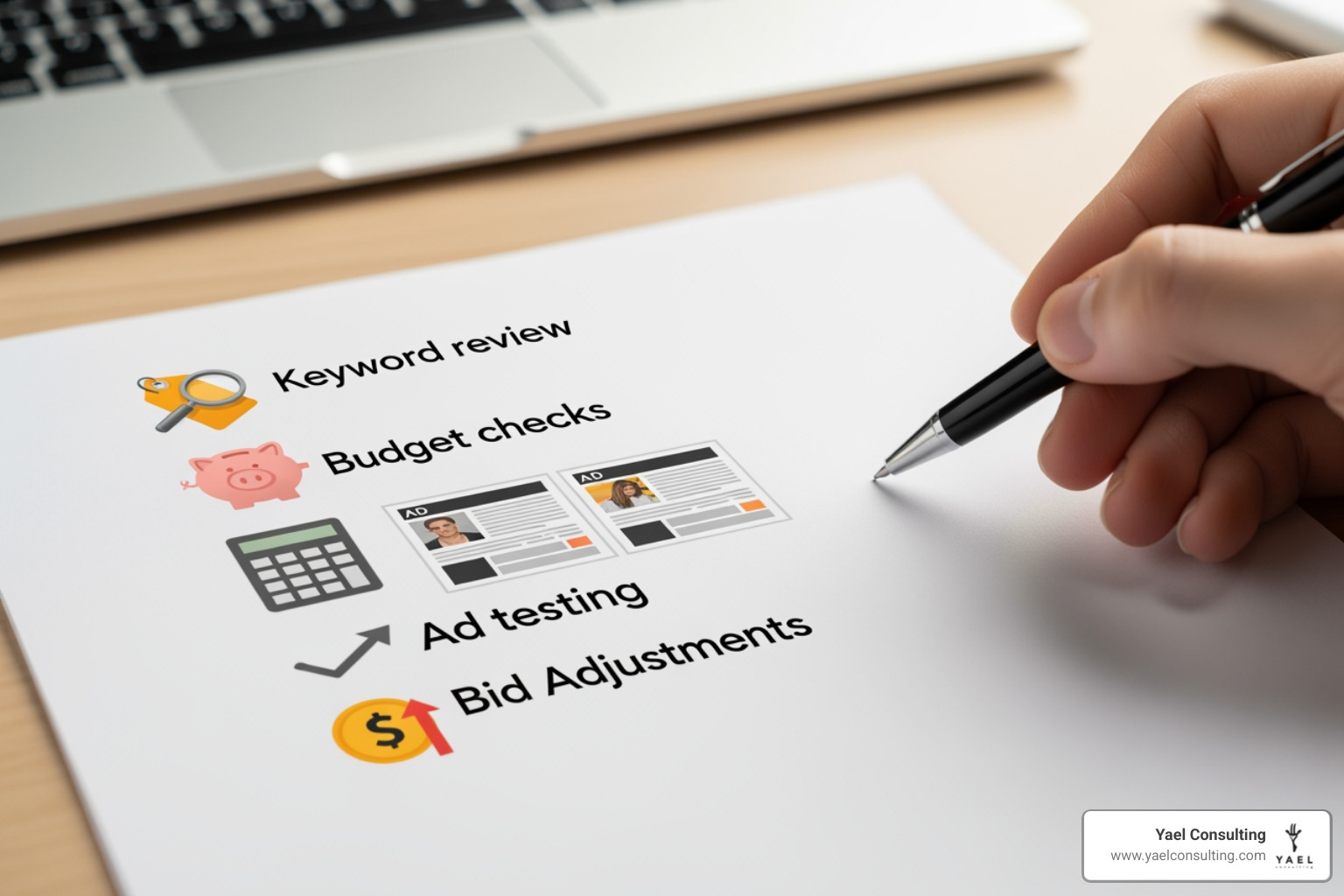
- Keyword Research Best Practices: Our approach to keyword research goes beyond basic tools. We use Google Ads Keyword Planner to identify new terms and even leverage PPC spy tools like SpyFu to analyze competitor strategies, uncovering untapped opportunities. The goal is to choose keywords that reach qualified buyers, focusing on commercial intent. For more, check out A PPC Consultant Tips for Keyword Research.
- Refining with Negative Keywords: Negative keywords are your secret weapon against wasted spend. We use them extensively to prevent ads from showing for irrelevant searches. For example, if you sell “apple” products, you’d add negatives like “apple pie recipe” or “apple orchard.” Regularly checking the search terms report allows us to continuously refine these lists, ensuring your budget is spent on qualified leads. Our guide on How to Use Keyword Match Types provides more detail.
- SKAGs (Single Keyword Ad Groups): For maximum control and relevance, we sometimes implement Single Keyword Ad Groups (SKAGs). This involves creating an ad group for each highly specific keyword, allowing us to craft hyper-relevant ad copy. Our client, Mold Inspection Sciences, halved their cost per lead and increased their conversion volume by 300% by implementing and optimizing SKAGs.
- Search Partners: Google’s Search Partners network can extend your reach, but its performance varies. We evaluate whether Search Partners are driving profitable conversions for each campaign. If they’re not, we’ll exclude them to prevent wasted spend.
- RLSAs (Remarketing Lists for Search Ads): Remarketing isn’t just for display campaigns. We layer Remarketing Lists for Search Ads (RLSAs) on top of our search campaigns to target users who have previously visited your site. This allows us to bid more aggressively or show different ads to an audience already familiar with your brand, significantly improving keyword effectiveness.
- Customer Match Lists: Personalization is key, with 71 percent of consumers valuing a custom experience. We automate the refreshing of Customer Match lists by linking a Google Spreadsheet with customer data. This ensures these lists are always up-to-date, allowing for highly personalized targeting and retargeting efforts.
Ad Copy, Assets & Landing Pages
- Ad Relevance & Quality Score: Matching ad copy and landing page content to users’ search terms creates a more personalized and relevant experience, crucial for 71 percent of consumers. This boosts your Quality Score, which in turn can lead to lower costs and better ad placement. Understanding your Quality Score Breakdown From a Google AdWords Consultant is essential.
- A/B Testing Ad Variations: We continuously test different headlines, descriptions, and calls-to-action to find what resonates best with your audience. Leasecake increased their conversion rate by 67% and decreased their CPA by 34% through prudent ad copy A/B testing.
- RSA Ad Strength: For Responsive Search Ads (RSAs), we pay close attention to Ad Strength, Google’s measure of how well your ad copy is set up. We monitor asset-level performance, identifying weak headlines or descriptions and replacing them with stronger, data-backed alternatives.
- Destination URL Checks: Broken or outdated destination URLs lead to wasted ad spend and a poor user experience. We regularly check and maintain all destination URLs, ensuring users land exactly where they expect.
- Sitelink Review & Update: Sitelinks and other ad assets should be reviewed and updated frequently. We ensure they link to relevant pages, reflect current promotions, and provide valuable additional information to users.
- Data for Fine-tuning Ad Messages: Every click and impression provides data. We use this data to fine-tune ad messages, ensuring they are as relevant and persuasive as possible. This iterative process of testing, analyzing, and refining is at the core of effective Adwords campaign optimization.
- Matching Intent to CTA: The call-to-action (CTA) on your ad and landing page must match the user’s intent. For high-intent searches, a direct “Buy Now” might work. For broader searches, a “Learn More” or “Download Guide” might be more appropriate. We saw a client decrease CPA by over 72% and increase conversion volume by 958% by matching CTA to the appropriate search temperature. For more on optimizing your landing pages, refer to Creating Landing Pages That Convert.
Bidding, Budgeting & Bid Adjustments
- Automated vs. Manual Bidding: While automated bid strategies like Maximize Conversions or Target CPA can be powerful, they require sufficient data (15-30 conversions per month) to learn effectively. For newer campaigns or those with limited data, manual bidding might offer more granular control. We consider the nuances of The Art and Science of How to Bid on Google AdWords for each campaign.
- Rebalancing Budgets: We regularly analyze spend across campaigns, identifying those that are underspending and those that are hitting budget limits prematurely. Reallocating unused budgets to high-performing campaigns ensures your money is always working efficiently.
- Dayparting (Ad Scheduling): Why show ads at 2 AM if your customers only convert between 9 AM and 5 PM? Dayparting allows us to optimize ad spend based on conversion times, ensuring your ads are visible when they’re most likely to lead to a sale.
- Geolocation Optimization: We use geolocation data to optimize ad spend by identifying top-performing locations. We adjust bids for specific areas or exclude low-performing regions entirely, ensuring your ads reach customers in your service areas (USA, Israel, New York, Los Angeles, etc.) without wasting clicks elsewhere.
- Demographic Targeting: Analyzing demographic data (age, gender, household income) helps us understand who is converting. We use this to apply bid adjustments or exclude segments that aren’t performing well, refining our targeting even further.
- Bid Adjustments: We strategically use bid adjustments across devices, audiences, locations, and ad schedules to fine-tune performance. For example, a two-second device bid adjustment modification resulted in a +125% increase in conversion volume to desktop for one campaign. Our guide on AdWords Bid Modifier Best Practices offers more insights.
Advanced Metrics for Adwords Campaign Optimization
- Impression-to-Conversion Rate (ITC): Instead of looking at CTR and conversion rate separately, we create a custom metric in Google Ads: the impression-to-conversion (ITC) rate. This provides a more comprehensive view by showing how many impressions it takes to generate a conversion. It’s calculated as Conversions / Impressions * 100.
- ROAS & CPA: Return on Ad Spend (ROAS) and Cost Per Acquisition (CPA) are critical for measuring true profitability. We prioritize these macro metrics over micro metrics like CPC, ensuring our optimizations lead to actual business growth.
- Conversion Value: For e-commerce businesses, tracking conversion value allows us to optimize for higher-value sales, not just more conversions.
- Attribution Models: Understanding how different touchpoints contribute to a conversion is crucial. We dig into various What Are Attribution Models in Google AdWords? to accurately credit the right ads and keywords.
- Matching Intent to CTA: As mentioned, matching the user’s intent to your Call-to-Action (CTA) is paramount. This applies across different campaign types, from a direct “Buy Now” for search ads targeting commercial intent to a softer “Learn More” for display ads aimed at brand awareness.
Structuring Your Optimization Workflow
Consistency is the secret sauce of successful Adwords campaign optimization. Without a structured routine, it’s easy for accounts to languish, budgets to be wasted, and opportunities to be missed. We believe that preventing account neglect is just as important as implementing new strategies. Our team, comprised of Great PPC Managers First Thing Morning, understands that daily vigilance and a systematic approach are key.
A Recommended Optimization Timeline
Here’s a breakdown of how we structure our optimization efforts:
- Daily:
- Budget Pacing: Check if campaigns are on track to spend their daily budget or if they’re over/underspending.
- Ad Disapprovals: Look for any disapproved ads that need immediate attention.
- Performance Fluctuations: Monitor for significant, unexpected drops or spikes in key metrics (e.g., a sudden drop in conversions or a spike in CPC).
- Weekly/Bi-weekly:
- Search Terms Report: Dive into the search terms report to add new negative keywords and identify new, high-performing keywords to add to campaigns.
- Bid Adjustments Review: Re-evaluate bid adjustments for devices, locations, demographics, and ad schedules based on recent performance data.
- Keyword Performance: Pause underperforming keywords and explore new expansion opportunities.
- Ad Asset Review: Check sitelink performance and update as needed.
- Monthly:
- Ad Testing & Rotation: Launch new ad variations and evaluate the performance of ongoing A/B tests. Pause underperforming ads.
- Budget Reallocation: Reassess overall budget allocation across campaigns based on performance and business goals.
- Campaign Settings Review: Check campaign settings like bidding strategies, conversion goals, and ad rotation.
- Landing Page Analysis: Review landing page performance and identify areas for improvement.
- Quarterly:
- Account Structure Review: Evaluate the overall account structure. Are SKAGs still effective? Are there opportunities to consolidate or expand campaigns?
- Goal Review: Realign campaign goals with broader business objectives.
- New Features & Betas: Explore new Google Ads features or beta programs that could benefit the account.
- Competitor Analysis: Conduct a deeper dive into competitor strategies.
Optimizing Specific Campaign Types
While many optimization principles apply universally, different campaign types offer unique opportunities for Adwords campaign optimization.
- YouTube Campaigns: YouTube offers immense potential for reach and engagement. We optimize YouTube campaigns by refining audience targeting (e.g., custom intent, in-market audiences), testing different video ad formats (skippable in-stream, bumper ads), and analyzing view-through conversions to understand their impact on the sales funnel. For more on maximizing your video ads, check out How to Make Your YouTube Channel More Popular.
- Display Campaigns: Display ads are fantastic for prospecting and feeding the sales funnel. We optimize them by focusing on audience targeting (in-market, custom intent, similar segments), refining placements, and A/B testing different ad creatives. While they may have lower direct conversion rates, their role in brand awareness and nurturing future conversions is invaluable. For expert tips, see Display Campaigns Expert Tips From an AdWords Consultant.
- Performance Max: Performance Max campaigns leverage Google’s AI to find converting customers across all Google Ads channels (Search, Display, YouTube, Find, Gmail, Maps). Optimization involves feeding the system with strong audience signals, high-quality creatives, and accurate conversion tracking. We continuously refine these inputs to guide the AI towards better results.
- Smart Campaign Optimization: For businesses using Smart Campaigns, optimization focuses on ensuring the foundational elements are strong. This includes choosing the right keyword themes that are accurate and precise. We carefully check location settings to target customers effectively in areas like New York or Los Angeles. Regularly reviewing your budget ensures it balances exposure with your comfort level. For more detailed guidance, explore Improve your Smart campaign’s performance.
- Writing Effective Ads for Smart Campaigns: Even in Smart Campaigns, effective ad copy is paramount. We focus on writing between 3 and 15 headlines (max 30 characters each) and 2 to 4 descriptions (max 90 characters each). We ensure keyword relevance by aligning ad copy with chosen keywords and improve ad strength by adding unique headlines. Google will automatically test these variations to find the best-performing ad.
Frequently Asked Questions about Adwords Campaign Optimization
How often should I optimize my Google Ads campaigns?
It depends on the task. Check for critical issues daily (budget, ad disapprovals). Review performance and refine targeting weekly (search terms, bids). Conduct deeper analysis and test new ads monthly. Re-evaluate overall strategy quarterly. Making small, consistent changes is more effective than infrequent, large overhauls.
What is a good Google Ads Optimization Score?
While 100% is the ideal, it’s not always achievable or necessary. A score above 80% is generally considered good. Focus on applying recommendations that align with your business goals rather than just chasing a perfect score. As we’ve seen, a 10-point increase can lead to a median 14% increase in conversions, demonstrating the real-world impact of strategic optimization.
Should I use automated or manual bidding?
It depends on your goals and data volume. Automated strategies like Maximize Conversions or Target CPA are powerful but require sufficient conversion data to work effectively (typically 15-30 conversions per month per campaign). Manual CPC offers more granular control, which can be better for new accounts or highly specific goals where you need precise control over every bid. We often start with automated strategies and fine-tune with bid adjustments as data accrues.
Conclusion
From understanding your financial bedrock to diving deep into tactical adjustments and maintaining a consistent optimization workflow, mastering Adwords campaign optimization is a continuous journey. It’s about combining strategic foresight with meticulous execution, always guided by data and your ultimate business goals.
At Yael Consulting, we’ve spent over 15 years refining this approach, helping businesses in the USA, Israel, New York, and Los Angeles not just run ads, but run profitable, growth-driven campaigns. Our proprietary technology and direct CEO involvement ensure that every dollar you spend is optimized for maximum impact.
Ready to transform your Google Ads performance from good to great? We invite you to experience the difference our expertise can make.
Get a free, actionable analysis from our AdWords consultants


Ex Special-Ops commander turned Google Ads expert and online marketing consultant. In minutes I will show you exactly how I will improve your profits (no fluff), backed by a 30-day guarantee. Feel free to contact me.
Lior is an expert in online marketing, strategy, operations, and technology. In his experience with diverse industries, military, and small and fortune-500 companies, he personally increased sales and productivity, built reporting platforms, and cut wasteful costs, all to ultimately hit company goals.
Lior has passion for learning, curiosity, and genuine commitment to get results. He enjoys working with high-performance and results-driven teams and performs best in environments that strive for excellence.
Specialties: Search Engine Marketing (SEM, PPC, Paid Search), Google Adwords, Bing-Yahoo Marketing, Landing Page Optimization. Data, ROI, and LTV Analytics, Report and Process Automation.