

Why Your E-commerce PPC Strategy Determines Whether You Profit or Bleed Ad Spend
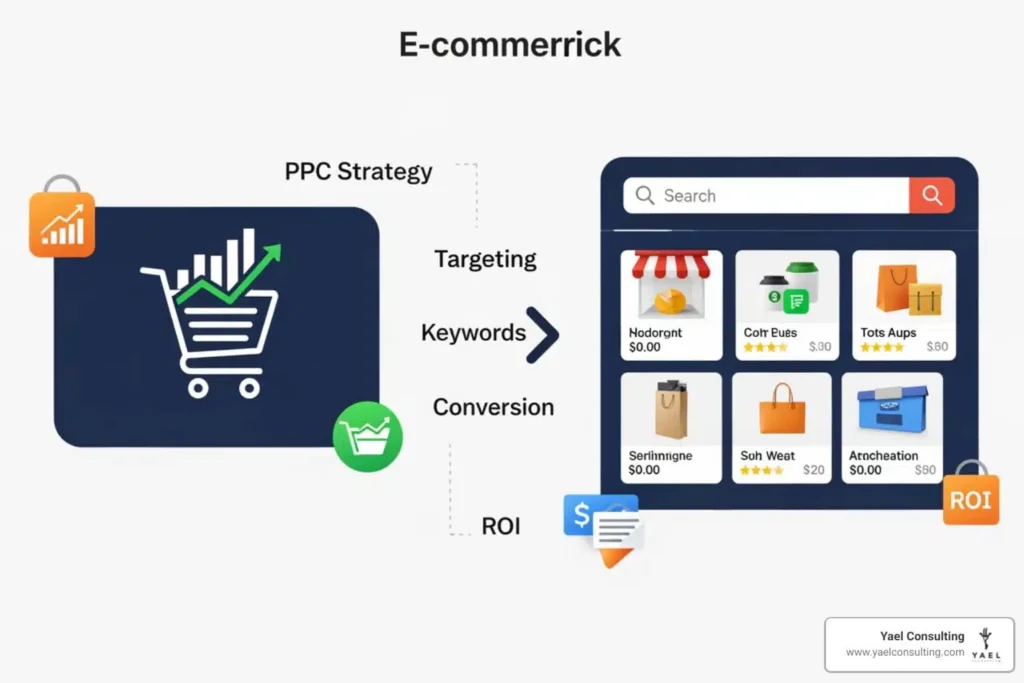
A solid e-commerce PPC strategy is the difference between ads that generate predictable revenue and campaigns that quietly drain your budget with little to show for it. Here’s what a winning strategy looks like at a glance:
- Set clear goals – Define target ROAS, CPA, and revenue benchmarks before spending a dollar
- Research high-intent keywords – Focus on long-tail, transactional terms with lower competition
- Structure campaigns logically – Organize by product category, margin, or brand vs. non-brand
- Write compelling ads – Lead with your unique value, strong CTAs, and relevant extensions
- Optimize landing pages – Match your ad’s promise exactly; speed and clarity drive conversions
- Choose the right bidding strategy – Start with smart bidding, then refine as data accumulates
- Retarget and automate – Use dynamic remarketing and AI tools to recover lost sales at scale
- Monitor and iterate – Track ROAS, CTR, and CPA weekly; cut waste, scale what works
The numbers make the case plainly. Businesses earn an average of $2 for every $1 spent on Google Ads – and well-optimized campaigns can push that to $8. PPC campaigns also deliver 50% higher conversion rates compared to other traffic sources when managed properly. Yet most e-commerce businesses leave that upside on the table because their strategy is either too broad, poorly structured, or never tested rigorously.
This guide walks you through every layer of a high-performance e-commerce PPC strategy – from keyword research and campaign architecture to AI automation and 2026 trends – so you can stop guessing and start scaling.
I’m Lior Krolewicz, a former Special Ops commander turned Google Ads expert who has helped businesses direct millions in advertising dollars toward profitable growth using data-driven e-commerce PPC strategy. Over 15 years in the field – working across small businesses and Fortune 500 companies – I’ve built the systems and frameworks that separate campaigns that compound returns from ones that just burn budget.
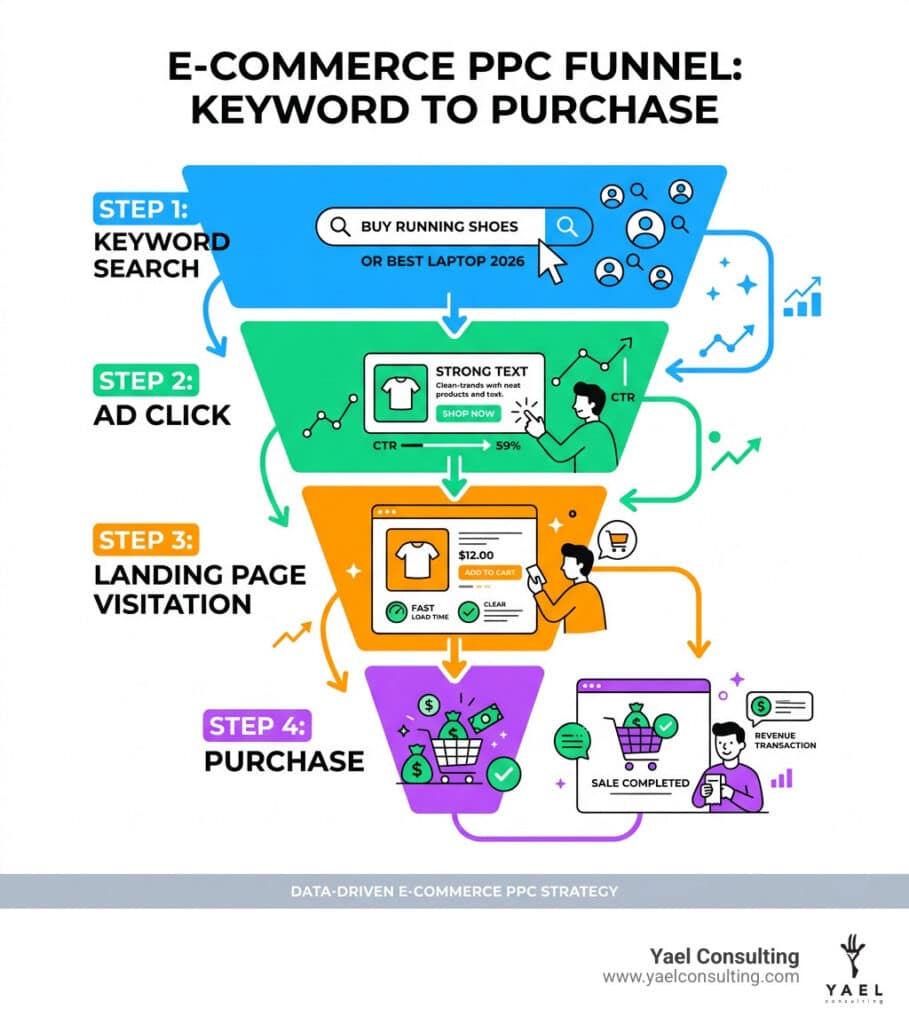
Key E-commerce PPC strategy vocabulary:
Building a High-Performance E-commerce PPC Strategy
In the world of online retail, your E-commerce PPC strategy acts as the digital storefront’s primary engine. Unlike organic SEO, which takes months to build momentum, Pay-Per-Click (PPC) allows you to appear at the very top of search results instantly. This is critical when you consider that Google’s global search engine market share sits at a dominant 89.57%. If you aren’t visible there, you effectively don’t exist to the majority of shoppers.
However, visibility isn’t enough. To truly succeed, you need to understand that e-commerce PPC benefits go far beyond just “getting clicks.” A well-crafted strategy provides superior control over your brand awareness, allows for laser-focused audience targeting, and offers measurable ROI that traditional advertising simply cannot match.
Setting Clear Goals and Success Metrics
Before you even log into Google Ads, we must define what “success” looks like. Running a campaign without SMART goals (Specific, Measurable, Achievable, Relevant, Time-bound) is like sailing without a compass. You’ll move, but you won’t know where you’re going.
We recommend focusing on these core Key Performance Indicators (KPIs):
- Return on Ad Spend (ROAS): This is the “North Star” for most retailers. If you spend $1,000 and generate $4,000 in revenue, your ROAS is 4:1 (or 400%).
- Cost Per Acquisition (CPA): How much does it cost to get one new customer? This must be lower than your profit margin for the campaign to be sustainable.
- Average Order Value (AOV): By tracking AOV, you can identify if your ads are attracting “window shoppers” or high-value customers.
- Conversion Rate: The percentage of clicks that turn into sales. The average for search ads is roughly 2.81%, but top-tier stores often see much higher.
Advanced Keyword Research: Long-Tail and Negative Keywords
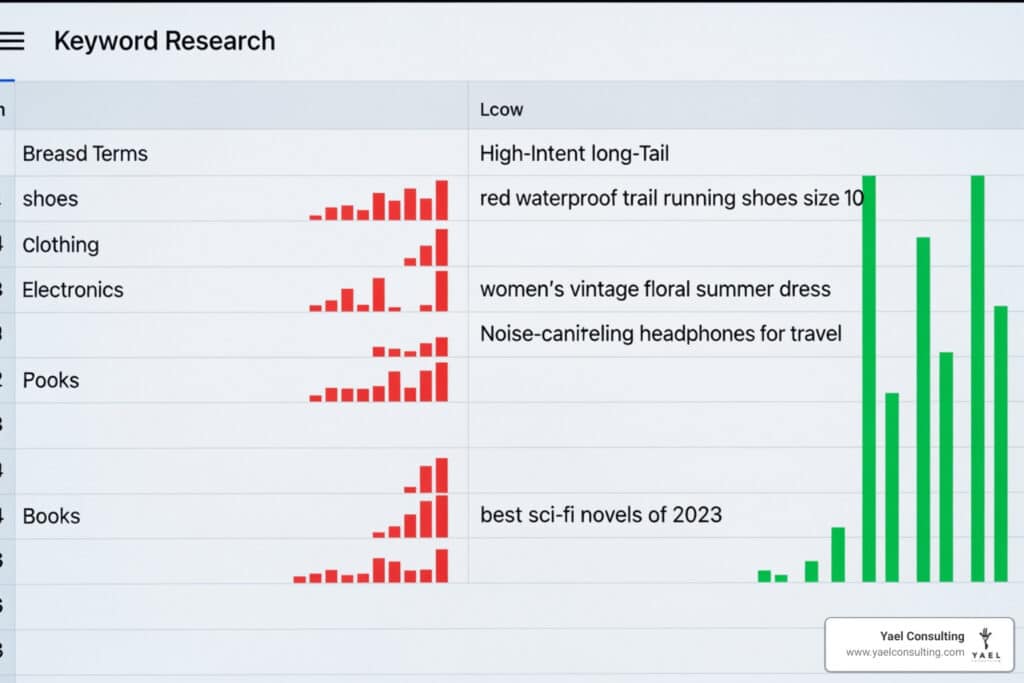
Keywords are the GPS of your E-commerce PPC strategy. If you target terms that are too broad—like “shoes”—you’ll attract people looking for “shoe repair,” “shoe history,” or “free shoes.” This is how budgets bleed out.
Instead, we focus on long-tail keywords. These are ultra-specific phrases like “red waterproof trail running shoes size 10.” While they have lower search volume, the long-tail keywords conversion rate is a staggering 36% on average. This is because the user’s intent is crystal clear; they are ready to buy.
Equally important is your negative keyword list. This is a list of terms you don’t want to show up for. For example, if you sell luxury watches, you should add “cheap,” “free,” “replica,” and “DIY” to your negative list. This prevents wasted spend on clicks that will never convert into a sale.
Campaign Architecture and Bidding for Scalability
A messy account structure leads to messy results. To scale an e-commerce business, your account hierarchy must be organized logically. This allows you to allocate budget to your “winners” and cut the “losers” without affecting the rest of your catalog.
| Feature | Manual CPC | Automated Bidding (Smart Bidding) |
|---|---|---|
| Control | Absolute control over every cent | Platform handles bid adjustments |
| Efficiency | Time-consuming for large catalogs | Highly efficient and scalable |
| Data Requirement | Works with zero data | Needs ~15-30 conversions/month |
| Best For | New accounts or niche products | Established accounts seeking growth |
Structuring Your E-commerce PPC Strategy for Growth
We advocate for a structure that reflects your business’s physical reality. This often means sorting campaigns by:
- Product Categories: (e.g., “Men’s Sneakers,” “Women’s Boots”)
- Gross Margins: Highly profitable items deserve a higher bid than low-margin accessories.
- Brand vs. Non-Brand: Keep your own brand name in a separate campaign. It usually has a very high ROAS, and mixing it with general terms can skew your data.
For retailers with large catalogs, following Google Merchant Center best practices is mandatory. Your product feed is the backbone of your Shopping ads and Performance Max campaigns. If your titles are vague or your images are low-quality, your ads won’t show—no matter how high you bid.
Bidding Strategies: Manual CPC vs. Target ROAS
Choosing a bidding strategy is where the “science” of PPC happens.
- Manual CPC: Great for beginners who want to learn the ropes or for launching a brand-new product.
- Target ROAS (tROAS): This uses machine learning to bid more aggressively on users who are likely to spend more. It’s the gold standard for mature e-commerce accounts.
- Maximize Conversions: If your goal is pure volume (clearing out old stock, for instance), this tells Google to get as many sales as possible within your daily budget.
We often use “Portfolio Bid Strategies” to group campaigns with similar goals together, allowing Google’s AI to learn faster across a wider pool of data.
Creative Excellence: Ad Copy, Visuals, and Landing Pages
You can have the best targeting in the world, but if your ad looks like spam, nobody will click. In the split second a user scrolls through search results, your ad needs to “stop the scroll.”
Designing High-Converting Visuals and Copy
The human brain processes images 60,000 times faster than text. This makes high-resolution imagery and video ads non-negotiable for 2026. Your visuals should be consistent with your brand and highlight your Unique Selling Propositions (USPs)—like “Free 2-Day Shipping” or “Handmade in the USA.”
When it comes to ad copy, we use Responsive Search Ads (RSAs). We provide Google with multiple headlines and descriptions, and its AI tests different combinations to see which one performs best. Don’t forget to use every available ad extension:
- Sitelinks: Direct users to specific pages like “New Arrivals” or “Sale.”
- Promotion Extensions: Highlight active discounts (e.g., “Save 20% for Black Friday”).
- Image Extensions: Add a small product thumbnail next to your text ad to boost CTR.
Optimizing the Post-Click Experience
The “ad-to-page scent” is vital. If your ad promises “50% off blue running shoes,” and the user lands on your homepage looking at “winter coats,” they will bounce immediately.
To maximize conversions, your landing pages must be:
- Fast: Every second of load time can decrease conversions by 7%.
- Mobile-First: With over 5.8 billion mobile subscribers globally, your checkout process must be seamless on a thumb-sized screen.
- Trust-Heavy: Include reviews, security badges, and clear return policies.
- Relevant: The landing page should be a direct continuation of the ad’s promise.
Advanced Tactics: Remarketing and AI Automation
Most people don’t buy on their first visit. In fact, retargeting can win back more than 15% of shoppers who were considering a purchase.
Leveraging First-Party Data and Dynamic Remarketing
As third-party cookies phase out, your first-party data (your email list and customer purchase history) becomes your most valuable asset. Using “Customer Match,” we can upload your encrypted email list to Google and show ads specifically to your existing customers or people just like them.
Dynamic Remarketing takes this a step further. If a user looked at a specific pair of hiking boots on your site but didn’t buy, we can show them an ad featuring those exact boots an hour later on YouTube or a news site. This “reminder” is often what triggers the final sale. Use audience segmentation insights to treat a “cart abandoner” differently than someone who just glanced at your blog.
The Future of E-commerce PPC Strategy in 2026
By 2026, the E-commerce PPC strategy landscape will be almost entirely AI-driven. We are already seeing the shift toward:
- Predictive Analytics: AI that forecasts seasonal demand before it happens.
- Visual & Voice Search: People taking photos of products to find them online or asking their smart speakers to “reorder my favorite coffee.”
- Search Generative Experience (SGE): Google’s AI-powered search results will change how ads are displayed, making “conversational” keywords more important than ever.
- Video-First Strategies: Short-form video ads (like those on YouTube Shorts) will be the primary driver of brand discovery for Gen Z and Millennial shoppers.
Frequently Asked Questions about E-commerce PPC
What is a realistic budget for e-commerce PPC?
While successful e-commerce businesses often invest between $9,000 to $10,000 monthly, you don’t have to start there. We recommend a “test and scale” approach. Start with a budget that allows for at least 50-100 clicks per day so you can gather data quickly, then increase spend by 10-20% increments as you hit your ROAS targets.
How long does it take to see results from PPC campaigns?
You will see traffic within minutes of your ads going live. However, “results” (profitable, stable performance) usually take 30 to 90 days. The first month is for data collection, the second for optimization, and the third for scaling.
Should I prioritize Google Shopping or Search ads?
For e-commerce, Shopping ads are almost always the priority. They show the product image and price upfront, which leads to higher-intent clicks. However, Search ads are excellent for capturing “problem-aware” shoppers (e.g., “best shoes for back pain”) or for protecting your brand name from competitors.
Conclusion
Building a winning E-commerce PPC strategy isn’t a “set it and forget it” task. It requires a relentless focus on data, a deep understanding of your customer’s journey, and the agility to adapt to the rapid AI advancements we’ll see through 2026. From the foundational work of keyword research to the advanced implementation of dynamic remarketing, every piece of the puzzle must fit perfectly to drive sustainable growth.
At Yael Consulting, we’ve spent over 15 years refining these frameworks. We don’t just “manage” ads; we partner with you to turn your advertising spend into a profit-generating machine. Because we offer one-client-per-market exclusivity, we are fully invested in making sure you dominate your niche.
Are you ready to stop guessing and start growing? Get a free 15-minute Google Ads analysis today. We’ll dive into your account, identify exactly where you’re wasting money, and show you the path to a higher ROAS. No fluff, just actionable value.