

Why Advanced Google Ads Strategies Matter More Than Ever
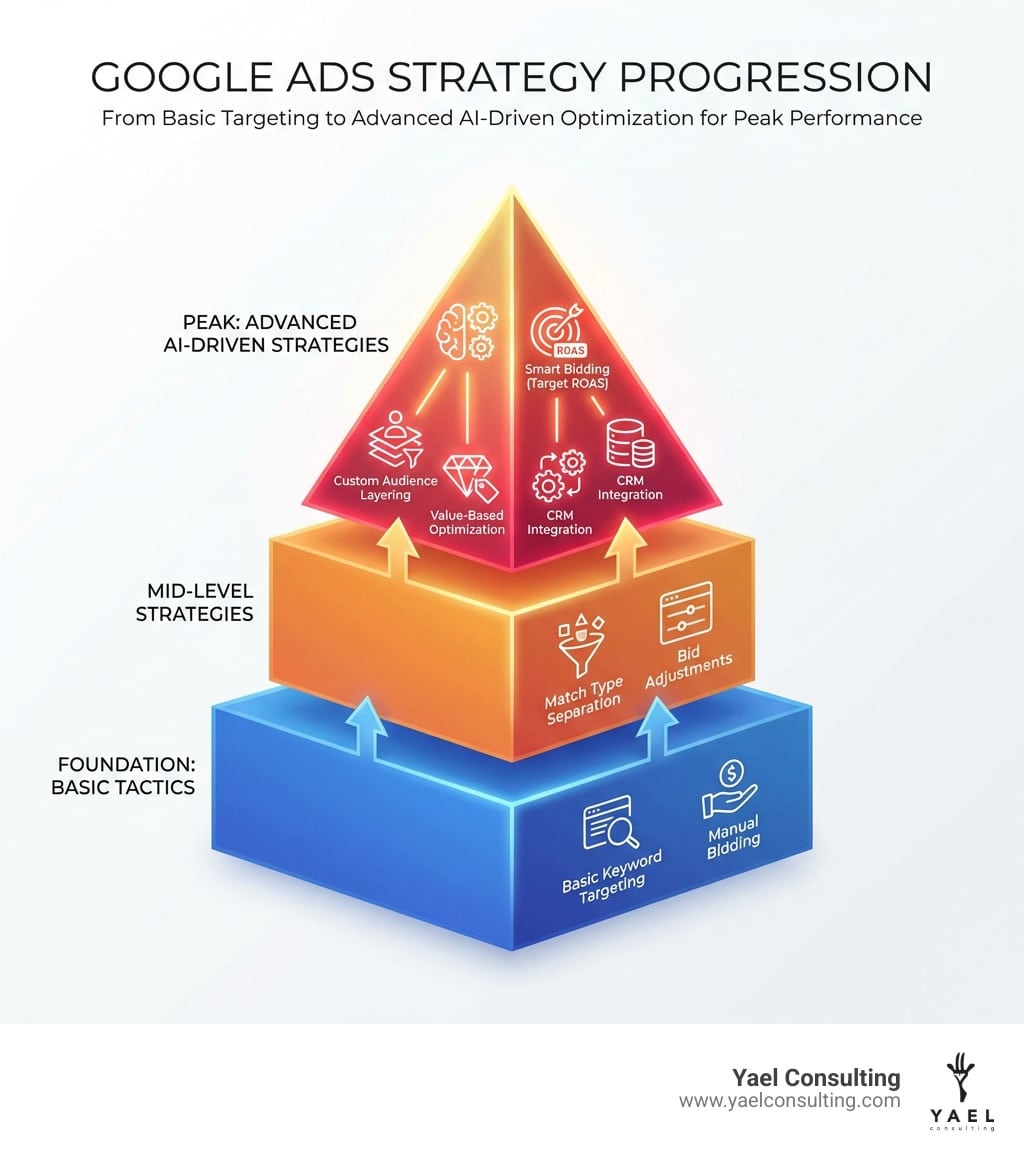
Advanced Google Ads strategies are the difference between wasting ad spend and driving profitable growth. They go beyond basic keyword bidding, leveraging AI-powered bidding, sophisticated audience targeting, value-based optimization, and deep business integration to maximize return on ad spend (ROAS) and customer lifetime value (CLV).
Key Advanced Strategies Include:
- Smart Bidding with AI: Target CPA, Target ROAS, and value-based bidding that optimize in real-time across 40,000 auctions per second
- Campaign Structure Optimization: Separating broad match keywords, implementing Single Keyword Ad Groups (SKAGs), and breaking out campaigns by ad schedule
- Advanced Audience Targeting: Custom segments, competitor conquesting, RLSAs, and in-market audiences
- Goal-Specific Tactics: Dominating Google Shopping, optimizing for qualified leads via CRM integration, and leveraging Performance Max
- Automation & Scripts: Using Google Ads scripts for bid management, performance monitoring, and custom reporting
- Strategic Troubleshooting: Fixing low Quality Scores, leveraging data exclusions, and applying seasonality adjustments
The real power of advanced strategies comes from understanding that Google Ads isn’t just about clicks or even conversions—it is about driving actual revenue and profit. A client of mine increased sales from $8,000 to $34,000 in just a few days by implementing multiple standard shopping campaigns. Another saw a 72% decrease in cost per acquisition simply by matching their call-to-action to search intent temperature.
However, advanced strategies only work when built on rock-solid fundamentals. You cannot skip keyword research, ad copy testing, or landing page optimization and expect AI to save you. The algorithm needs accurate conversion data, proper account structure, and clear business goals to work effectively.
The distinction between basic and advanced is about tailoring every campaign element to your unique business model—your profit margins, customer lifetime value, and long-term goals. It is about understanding that a lead from a high-value prospect is worth more than one from an unqualified source, even if Google’s algorithm does not know that yet.
I’m Lior Krolewicz, a Google Ads expert who has directed millions in ad spend for diverse industries. Using proprietary systems and disciplined execution frameworks, I’ve helped clients achieve results like 411% increases in productivity and 23% improvements in campaign performance by applying advanced Google Ads strategies that go beyond the standard playbook.
Foundational Mastery: The Bedrock of Advanced Success
The journey to advanced Google Ads strategies begins with mastering the fundamentals. A weak foundation undermines even the most complex campaigns. While basic strategies involve simple ads and keywords, advanced strategies dig deeper. They are customized to a business’s unique needs, integrating audience targeting, various campaign types, and AI.
This foundational mastery includes:
- Keyword Research: Going beyond what people search for to understand why. This uncovers low-competition keywords and helps categorize them by user intent (informational, commercial, etc.).
- Ad Copy: Crafting compelling ad copy that speaks to the searcher’s intent. Continuous A/B testing is crucial. Our client, Leasecake, increased their conversion rate by 67% and decreased their CPA by 34% through prudent ad copy A/B testing.
- Bidding and Budgeting: Moving beyond simple daily budgets to strategic allocation based on performance, seasonality, and business goals.
- Relevant Landing Pages: Ensuring the ad experience transitions seamlessly to a relevant landing page with a clear path to conversion.
- Business Fundamentals: Understanding a client’s UVP, audience, CLV, profit margins, and overall strategy is key. This allows us to tailor Google Ads to unique business models and long-term goals, like prioritizing CLV over immediate sales. For example, we shifted an e-commerce client’s focus after finding significant revenue came from long-term maintenance plans.
We also consider the “Iceberg Effect” in PPC accounts, where visible keywords often do not match underlying search terms, making search term report analysis essential. Furthermore, maintaining a strong ad quality score is paramount, as it impacts ad rank and CPC. Investing time in these core concepts sets us up for success.
Understanding Key Metrics for Diagnosis
To diagnose campaign issues, we dive deep into key performance metrics:
- Conversion Rates: The percentage of interactions that result in a desired action.
- Click-Through Rates (CTR): The ratio of clicks to impressions, indicating ad relevance.
- Cost Per Acquisition (CPA): The cost to acquire a single conversion, vital for lead generation.
- Return On Ad Spend (ROAS): Measures revenue generated per dollar spent, crucial for e-commerce.
- Quality Score: Google’s rating of your keyword and ad relevance.
- Search Impression Share: The percentage of impressions your ads received versus what they were eligible for.
Understanding these metrics in context helps pinpoint underperformance. A low CTR might indicate irrelevant ad copy, while a high CPA could point to inefficient bidding or a poor landing page. We focus on macro metrics like sales and ROAS over micro metrics like CTR, ensuring optimizations align with true business goals. For our client, Reliable Garage Door, matching our Call-to-Action to search temperature decreased CPA by over 72% and increased conversion volume by 958%.
The Critical Role of Client Collaboration
Client collaboration is a cornerstone of advanced Google Ads strategies. Deeper insights into a client’s business and market lead to more effective campaigns, refined through continuous communication.
When starting with a client, we ask key questions to gain a comprehensive understanding:
- What are your specific business goals? (for example, brand awareness, qualified leads, e-commerce sales)
- What is your Unique Value Proposition (UVP)? What makes you stand out?
- Who is your Target Audience? What are their pain points, motivations, and online behavior?
- What is your Customer Lifetime Value (CLV)? This determines profitable acquisition costs.
- Are there any specific market challenges? (for example, competitor pricing, seasonal demand)
This open dialogue allows us to develop custom strategies that resonate with the client’s business objectives.
Advanced Google Ads Strategies for Structure, Targeting, and Bidding
As Google Ads evolves with AI, campaign structures must adapt. Traditional hyper-segmentation can hinder AI, which works best with fewer constraints, allowing it to learn and optimize more efficiently.

Simplifying account structure requires robust data and thoughtfully themed ad groups. When data is de-duplicated and centralized around clear marketing objectives, the AI works better. As Google advises, to unlock AI’s power, simplify your Search campaigns. A simplified structure improves performance, accuracy, and insights.
Structuring Campaigns for Granular Control
Granular control means intelligent segmentation that empowers both human insight and AI.
- Separating Broad Match Keywords: Keep broad match keywords in separate campaigns to allow for different bidding strategies and simplified budget control.
- Single Keyword Ad Groups (SKAGs): While the landscape has shifted, SKAGs still offer granular control. For example, our client Mold Inspection Sciences halved their cost per lead and increased conversion volume by 300% using optimized SKAGs, which demonstrates the power of tightly themed ad groups.
- Ad Scheduling Breakouts: Breaking out campaigns by ad schedule allows for custom performance targets, which is effective for B2B campaigns that need to align with business hours.
- Geolocation Targeting and Dayparting: We use flexible budgeting and bid adjustments to allocate spend based on demand fluctuations and conversion patterns.
- Device Bid Adjustments: Optimizing bids by device is critical. A simple device bid adjustment led to a +125% increase in desktop conversion volume for one client.
Advanced Audience Targeting for Precision Reach
Advanced Google Ads strategies use sophisticated audience targeting to reach the most valuable prospects.
- Custom Segments: We create custom segments based on user interests, behaviors, and website history, allowing for highly targeted audiences.
- Competitor Targeting: We use custom segments for competitor conquesting by targeting users who have visited competitor websites, crafting messaging that highlights our client’s advantages.
- Remarketing Lists for Search Ads (RLSAs): RLSAs are ideal for brands with longer sales cycles. Layering remarketing audiences on search campaigns lets us tailor bids and ads for users who have already engaged with a site, increasing conversion likelihood.
- In-Market Audiences: These Google-curated audiences consist of users actively researching a purchase. We leverage them to highlight our client’s USPs to prospects who are ready to buy.
- Life Events, Detailed Demographics, and Affinity Audiences: These provide additional targeting layers to reach users during significant life moments or based on long-term interests.
- Layering Audiences: We often add audiences in “observation” mode to gather data before switching to “targeting” mode, ensuring our strategies are data-driven.
Mastering Advanced Bidding Strategies with AI
Google’s Smart Bidding has transformed bid management with AI-powered optimization. It uses machine learning and real-time signals (device, location, time of day, and more) to optimize bids for every auction.
- Aggressive vs. Efficient Bidding: We often use aggressive strategies like Maximize Conversions to expedite the learning phase for new campaigns, then switch to efficient strategies like Target ROAS or Target CPA to optimize for profitability.
- Target CPA vs. Target ROAS: Target CPA is ideal for lead generation, while Target ROAS is well-suited for e-commerce.
- Value-Based Bidding: This crucial strategy optimizes for true business impact by measuring conversion value (for example, lifetime value, revenue, profit) instead of just volume.
- Portfolio Bid Strategies: These optimize bids across multiple campaigns with similar goals, helping the algorithm learn faster.
- Improved CPC (eCPC): This balances manual control with automated adjustments, acting as a practical stepping stone to full Smart Bidding.
- Data Exclusions and Seasonal Adjustments: These are vital for informing Google’s AI. Data exclusions prevent algorithms from being skewed by anomalies, while seasonal adjustments help them anticipate performance fluctuations.
By leveraging these strategies, our client, One America Works, saw a 92% increase in conversions and a 66% decrease in CPA.
Goal-Specific Optimization: From E-commerce to High-Quality Leads
Advanced Google Ads strategies are not one-size-fits-all. They are customized to unique business models and long-term goals, considering factors like CLV, profit margins, and inventory. The right strategy can generate results across the entire sales funnel.
Dominating Google Shopping for E-commerce
For e-commerce businesses, dominating Google Shopping is a game-changer.
- Multiple Standard Shopping Campaigns: An aggressive, effective tactic is using multiple standard shopping campaigns for the same products to dominate the first page of results. One client saw sales jump from $8,000 to $34,000 in days with this method.
- Adapting to MAP Policy Violations: When competitors violate Minimum Advertised Price (MAP) policies, these multi-campaign strategies can be adapted to maintain visibility without engaging in price wars.
- Product Feed Optimization: This is the backbone of successful Google Shopping. We ensure product feeds are accurate, complete, and optimized with relevant keywords and Global Trade Item Numbers (GTINs).
Optimizing Lead Generation for Quality over Quantity
For lead generation, the goal is qualified leads, not just quantity.
- CRM Integration: Integrating Google Ads with a client’s CRM allows us to optimize for qualified leads. We track lead quality post-conversion, feeding data back to Google’s AI to focus on lower-funnel stages and prevent bot attacks by focusing on real business outcomes.
- Offline Conversion Tracking: For leads that convert offline, we implement offline conversion tracking to import data about lead quality (for example, qualified lead, sale closed) back into Google Ads, helping Smart Bidding find more valuable leads.
- Leveraging Ad Extensions: Ad extensions such as call extensions, lead form extensions, and sitelinks are critical for improving ad visibility and providing direct paths to conversion. Lead form extensions streamline lead capture directly from search results.
Leveraging Modern Campaign Types
Google’s evolving campaign types require a strategic approach.
- Video Assets: High-quality video is important for newer campaign types like Performance Max and Demand Gen. Google is emphasizing video, and Performance Max will create a default video if one is not provided, which may not align with your brand.
- Performance Max: This campaign type uses AI across all Google inventory. For best results, we often consolidate smaller campaigns into broader Performance Max campaigns to give the AI more data.
- Demand Gen Campaigns: These are designed to drive demand and consideration across YouTube, Find, and Gmail.
- Cross-Channel Synergy: We ensure Google Ads efforts complement PPC success, particularly through SEO. Strong SEO improves ad quality score and provides signals for Google’s AI, creating a holistic search presence.
Automation, Troubleshooting, and Staying Ahead
The Google Ads landscape is shifting toward AI and automation. A BCG study found 80% of marketers’ time is spent on manual tasks, leaving only 20% for strategy. Automation offers a major opportunity for efficiency, allowing a shift from repetitive tasks to high-level planning.
The world of Google Ads is dynamic, requiring continuous learning and adaptation. We must always be ready to experiment with new features and adjust our strategies.
Utilizing Google Ads Scripts for Advanced Automation
Google Ads scripts (JavaScript) automate tasks and enable advanced optimizations beyond the standard interface.
- Automating Bid Management: Scripts can adjust bids based on external data (for example, inventory levels) or custom performance thresholds.
- Performance Monitoring: We use scripts to monitor performance, automatically pausing underperforming ads or keywords.
- Custom Reporting: Scripts can generate highly customized reports for deeper insights.
- Keyword Management: Scripts can automate adding negative keywords or expanding keyword lists.
- Creative Customization: Scripts can even be used for advanced tasks like changing bids based on weather patterns.
Troubleshooting Common Campaign Issues
Even with advanced strategies, issues arise. Effective troubleshooting is key to maintaining performance.
- Low Quality Score: We troubleshoot this by improving ad relevance, optimizing the landing page experience, and working to improve expected CTR.
- Ad Disapprovals: We review disapproval notices and address policy violations quickly to get ads running again.
- Low Traffic: If traffic is low, we investigate by potentially increasing bids, broadening targeting, or improving ad quality.
- Poor Conversion Rates: Clicks without conversions often point to issues with the landing page, targeting, or bidding. We optimize landing pages, refine targeting, and adjust bids.
- Analyzing Search Term Reports: Regularly analyzing search term reports helps us find new negative keywords and uncover new keyword opportunities. We also leverage data from other ad platforms to inform our Google Ads campaigns.
Frequently Asked Questions about Advanced Google Ads
How do SEO efforts complement PPC success in Google Ads?
SEO and PPC work together to dominate search results.
- SEO Impacts ad quality score: A strong organic presence and high-quality site content improve your Quality Score, which leads to lower CPCs and better ad positions.
- Provides Signals for AI: Strong SEO gives Google’s algorithms more context about your business, improving ad relevance and targeting.
- Shared Keyword Data: SEO keyword research can inform PPC campaigns, and PPC data can reveal converting keywords worth targeting organically.
- Landing Page Relevance: An SEO-optimized landing page improves user experience, conversion rates, and Quality Score.
- Holistic Search Presence: Combining strong organic rankings with paid ads occupies more SERP real estate, increasing brand visibility and clicks.
What is the impact of pausing and restarting Google Ads campaigns?
Pausing and restarting campaigns, especially with automated bidding, has significant negative impacts.
- Disrupts Machine Learning: Pausing a campaign resets parts of the machine learning process. When restarted, the algorithm must re-learn, which can lead to temporary suboptimal performance.
- Potential for Higher CPC: During this re-learning phase, campaigns may experience higher CPCs and lower conversion rates.
- Weaker Historical Performance: Extended pauses can interfere with the continuity of performance data, which is one of the signals used by Google’s systems when evaluating ads.
Effective alternatives to pausing include several advanced Google Ads strategies:
- Budget Reduction: Gradually reduce the budget to a minimum instead of stopping it completely.
- Bid Adjustments: Apply negative bid adjustments to limit spend without pausing.
- Automated Rules: Set up rules to pause specific ads or ad groups, not entire campaigns.
- Dayparting: Adjust ad schedules to run only during peak hours.
- Seasonal Adjustments: Use this feature to inform Smart Bidding about expected performance changes.
What are some “hidden” features in Google Ads for better performance?
Google Ads has several powerful, underused tools that can significantly improve performance.
- Demographic Targeting for Search Ads: Apply bid adjustments for age, gender, or parental status in Search campaigns to prioritize high-converting audiences.
- Keyword-Level Auction Insights: This provides granular competitive data on impression share, overlap rate, and outranking share for individual keywords, informing bidding strategies.
- Seasonality Adjustments: Inform Smart Bidding about short-term conversion rate changes (1–7 days) due to events like sales, helping the algorithm capitalize on fluctuations.
- Data Exclusion: Tell Smart Bidding to ignore performance data from a specific period if you had a tracking outage. This prevents the algorithm from training on inaccurate data.
- Optimized Targeting in Display: This feature expands your reach beyond manual selections to find new, relevant audiences that are likely to convert. It requires close monitoring.
- Promotion Extensions: Highlight special offers and discounts directly in your search ads to drive higher click-through rates.
Conclusion: Achieve Peak Performance with Expert Strategy
Mastering Google Ads requires deploying sophisticated, data-driven advanced Google Ads strategies aligned with core business objectives. This involves a solid foundation, granular campaign structures, advanced audience targeting, AI-powered bidding, goal-specific optimization, and automation. The distinction between basic and advanced strategies is a holistic approach that connects every action to your overall business health, requiring continuous adaptation and a willingness to leverage cutting-edge tools.
At Yael Consulting, we bring over 15 years of expertise as a boutique Google Ads agency, specializing in driving significant sales and profit growth for e-commerce and lead generation businesses. Our proprietary technology, combined with a one-client-per-market exclusivity model and direct CEO involvement, ensures that our clients receive focused strategic guidance and disciplined execution. We do not just manage campaigns; we become an extension of your business, dedicated to achieving your specific growth objectives.
Whether you are starting out or refining your advanced Google Ads strategies, the key is to keep learning and adapting. With the right approach, you can dominate your market and achieve your business goals.
Ready to see how advanced Google Ads strategies can transform your business? Get your free, expert Google Ads analysis from Yael Consulting today. We guarantee actionable value in just 15 minutes.