
The Performance Playbook: Mastering Google Ads for Maximum Impact

Why Google Ads Performance Marketing is Your Growth Engine
Google Ads performance marketing is a results-driven approach where you only pay for measurable actions—clicks, conversions, or calls—that directly contribute to your business goals. Unlike traditional advertising where you pay for impressions and hope for results, performance marketing lets you track every dollar spent and tie it directly to revenue generated.
Core elements of Google Ads performance marketing:
- Measurable Results – Track every click, conversion, and dollar of revenue
- Action-Based Pricing – Pay only when users take specific actions (clicks, calls, purchases)
- Real-Time Optimization – Adjust campaigns based on live performance data
- Goal-Focused – Align campaigns with business objectives (sales, leads, traffic)
- Data-Driven Decisions – Use metrics like ROAS, CPA, and conversion rate to guide strategy
As one agency CEO put it: “There really is no better platform than Google Ads to reach the entire world.” And the numbers back this up. The average return on ad spend for Google Ads is roughly 200%, with properly optimized campaigns achieving 4:1 or even 8:1 returns.
Why it works: Google Ads puts you in front of high-intent users actively searching for what you sell. When someone types “sandwich delivery near me” or “best project management software,” they’re ready to take action. You’re not interrupting them—you’re answering their question at the exact moment they need a solution.
The challenge? Most businesses waste money on poorly structured campaigns, ignore critical metrics, or fail to track conversions properly. In fact, 42% of advertisers don’t track any conversions at all. Without proper tracking and optimization, you’re flying blind.
I’m Lior Krolewicz, and I’ve spent 15 years mastering Google Ads performance marketing, from leading campaigns at top advertising firms to building proprietary systems that optimize accounts in days instead of weeks. Through my work with Yael Consulting and the development of our IBEX technology, I’ve helped businesses transform wasted ad spend into profitable growth engines.
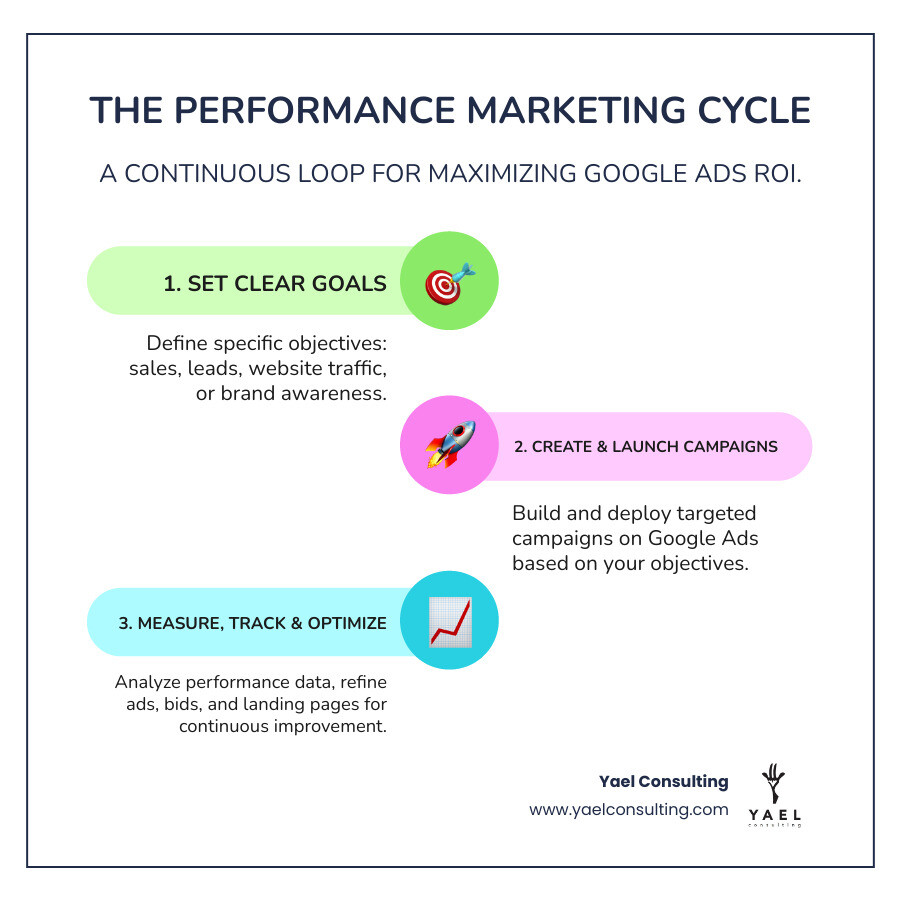
Laying the Foundation: Goals, Budget, and Strategy
Before we even think about keywords or ad copy, it’s crucial to lay a solid foundation. This means clearly defining our goals and carefully planning our budget. Without these two pillars, even the most brilliant ad campaigns can falter.
Defining Your Goals for Google Ads Performance marketing
Every successful Google Ads performance marketing campaign starts with a clear objective. What do you want your ads to achieve? Google Ads offers various campaign objectives, and selecting the right one is paramount to aligning your advertising efforts with your overall business outcomes.
Here are the primary goals we often see businesses aiming for:
- Sales Objective: This is often the holy grail for e-commerce businesses. Our focus here is on driving direct purchases, increasing average order value, and maximizing revenue. We optimize for actions like “add to cart,” “checkout initiated,” and “purchase.” For example, a client in Los Angeles selling custom apparel might aim to increase online sales by 20% quarter-over-quarter.
- Leads Objective: For lead generation businesses, such as a consulting firm in New York or a real estate agency in Israel, the goal is to capture contact information from potential customers. We track actions like form submissions, phone calls, and newsletter sign-ups. The aim is to generate high-quality leads that our sales team can then convert.
- Website Traffic Objective: Sometimes, the goal isn’t an immediate conversion but rather to drive more visitors to a specific page or section of your website. This could be for content marketing, product research, or simply increasing brand engagement. While not a direct conversion, increased relevant traffic can precede future conversions.
- Awareness and Consideration Objective: For new businesses or those launching a new product, the initial goal might be to get their brand in front of as many relevant people as possible or to encourage them to learn more. This is about building brand recognition and fostering interest before expecting a direct sale or lead. Think of a startup in the USA introducing an innovative tech product.
It’s essential to learn more about campaign objectives to ensure your chosen objective aligns perfectly with what you truly want to achieve. Misaligned goals can lead to wasted spend and frustration, like trying to win a marathon with a sprint strategy!
How to Determine Your Google Ads Budget
Once our goals are crystal clear, the next big question usually is: “How much budget do I really need?” This is where many businesses struggle, often guessing or setting arbitrary limits. But with Google Ads performance marketing, we can approach budgeting with a strategic, data-driven mindset.
Our budget calculation starts by looking at a few key metrics:
- Average CPC (Cost Per Click): This tells us how much we can expect to pay for each click on our ads. The benchmark for search ads is $2.69, while display ads are significantly cheaper at $0.63. These are averages, and your actual CPC will vary by industry, keywords, and competition. For instance, industries like Finance & Insurance ($3.44) and Real Estate ($3.80) tend to have higher CPCs on search than Ecommerce ($1.16).
- Conversion Rate: This is the percentage of clicks that turn into a desired action (a sale, a lead, etc.). If you have historical data, use it! If not, we can use industry benchmarks (e.g., 2.69% for Ecommerce, 2.41% for B2B) as a starting point.
- Industry CPA (Cost Per Acquisition): This metric tells us how much, on average, it costs to acquire one customer or lead. Benchmarks vary widely: for Ecommerce, it’s about $45.27, while for B2B, it can be as high as $116.13, and Technology at $133.52. Knowing this helps us understand the profitability of our campaigns.
Goal-oriented budgeting is our preferred approach. Instead of just picking a number, we work backward from our desired outcomes. For example, if a service-based business in New York wants 50 leads per month, has an average CPC of $2, and a 5% conversion rate:
- Clicks needed: 50 leads / 0.05 (5% conversion rate) = 1,000 clicks
- Monthly budget: 1,000 clicks * $2 CPC = $2,000 per month
We also need to consider daily vs. monthly budget. Google Ads operates on a daily budget, which means your actual spend might fluctuate slightly day-to-day, but it aims to stay within your monthly budget (daily budget x 30.4 days). It’s a bit like a flexible spending account for your ads.
It’s important to remember that budget isn’t just about spending; it’s about investment. We frequently monitor impression share and lost clicks to understand if we’re leaving conversions on the table due to insufficient budget. If our impression share is low on high-performing keywords, it’s a clear signal to increase our investment. You can learn more about managing your budget directly from Google.

Core Mechanics of Google Ads Performance Marketing
Now that we’ve set our goals and budget, let’s dive into the engine room of Google Ads performance marketing: the key metrics we track, how we ensure our efforts lead to tangible results, and how we continuously refine our strategy. This involves understanding our numbers, setting up proper tracking, and optimizing for efficiency.
Key Performance Metrics to Track for Success
In Google Ads, data is our best friend. We obsess over metrics because they tell us if our campaigns are performing, where they need improvement, and if we’re hitting our business objectives. Here are the crucial performance metrics we track:
- Click-Through Rate (CTR): This is the percentage of people who see your ad and click on it. It’s a primary indicator of how relevant and appealing your ad copy and targeting are. A high CTR often means a lower CPC and better ad positions. For Ad position 1, the benchmark CTR is 2.1%, while for Ecommerce, it’s 2.69%. If our CTR is low, we know our ads might not be resonating with our audience.
- Cost Per Click (CPC): The actual amount you pay each time someone clicks on your ad. This metric is influenced by your Quality Score, competition, and bidding strategy. As mentioned, benchmarks vary, but keeping an eye on this helps manage costs effectively.
- Cost Per Acquisition (CPA): This is the total cost divided by the number of conversions. It tells us the average cost to acquire a lead or a sale. This is a critical metric for profitability. If our CPA is too high, we need to optimize our campaigns to bring it down. Benchmarks for CPA also vary significantly by industry, from $33.52 for Auto to $133.52 for Technology.
- Conversion Rate (CVR): The percentage of users who complete a desired action after clicking your ad. A good CVR indicates that your landing page and offer are compelling. The average conversion rate for businesses with good conversion tracking is 3.16%, compared to 2.18% overall.
- Impression Share: This metric shows the percentage of times your ad was shown compared to the total number of times it could have been shown. A low impression share might indicate budget limitations or low Ad Rank. For low-competition keywords, we aim for 90-95%, while for highly competitive keywords, 60% is a reasonable benchmark.
- Return on Ad Spend (ROAS): This is a measure of the revenue generated for every dollar spent on advertising. The average ROAS for Google Ads is roughly 200%, meaning for every $1 spent, $2 is returned. Our goal for clients is often much higher, aiming for 4:1 or even 8:1 for many campaigns. Profit on Ad Spend (POAS) is an even more precise evaluation, excluding additional costs like taxes and shipping to give a clearer picture of net profit.
| Metric | Formula | What it indicates |
|---|---|---|
| Click-Through Rate (CTR) | (Clicks / Impressions) x 100% | The relevance of your ad. A high CTR shows your ad copy and targeting resonate with your audience. |
| Cost Per Click (CPC) | Total Cost / Number of Clicks | The actual cost for each click. Helps manage budget efficiency. |
| Cost Per Acquisition (CPA) | Total Cost / Number of Conversions | The cost to get one new customer or lead. This is a critical profitability metric. |
| Conversion Rate (CVR) | (Conversions / Clicks) x 100% | The effectiveness of your landing page and offer. Shows how many clicks turn into valuable actions. |
| Impression Share | Impressions / Total Eligible Impressions | Your ad’s visibility compared to its potential. A low share may signal budget or Ad Rank issues. |
| Return on Ad Spend (ROAS) | (Revenue from Ads / Ad Spend) x 100% | The revenue earned for every dollar spent. Measures the direct financial return of your campaigns. |


Ex Special-Ops commander turned Google Ads expert and online marketing consultant. In minutes I will show you exactly how I will improve your profits (no fluff), backed by a 30-day guarantee. Feel free to contact me.
Lior is an expert in online marketing, strategy, operations, and technology. In his experience with diverse industries, military, and small and fortune-500 companies, he personally increased sales and productivity, built reporting platforms, and cut wasteful costs, all to ultimately hit company goals.
Lior has passion for learning, curiosity, and genuine commitment to get results. He enjoys working with high-performance and results-driven teams and performs best in environments that strive for excellence.
Specialties: Search Engine Marketing (SEM, PPC, Paid Search), Google Adwords, Bing-Yahoo Marketing, Landing Page Optimization. Data, ROI, and LTV Analytics, Report and Process Automation.