
How to Grow Online Sales: Your Ultimate Promotion Guide

Why Growing Online Sales is the Ultimate Business Lever
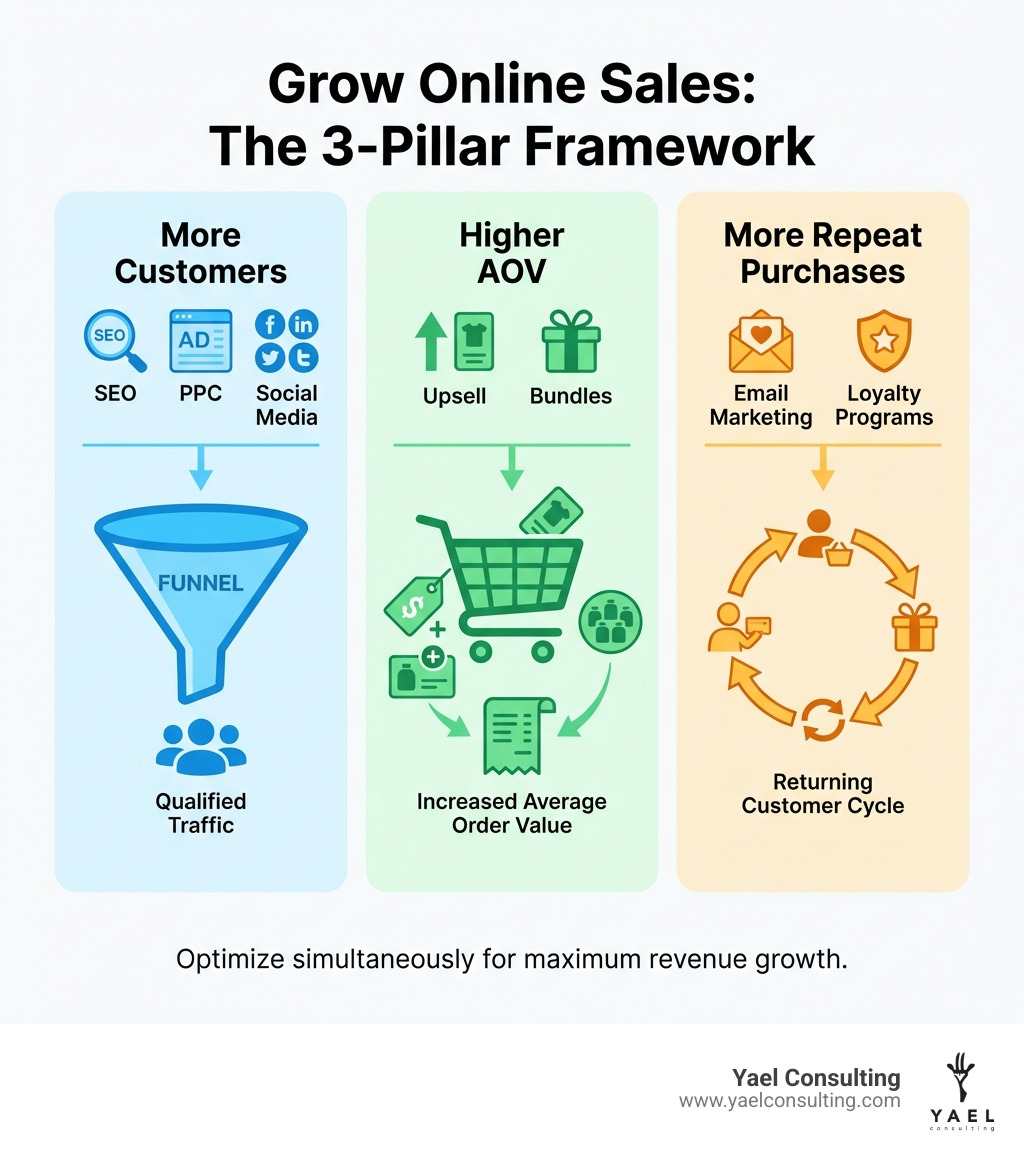
Grow online sales – it’s the heartbeat of every thriving online business. Unlike cutting costs or raising prices (which both hit a ceiling fast), sales growth is theoretically unlimited. Here’s the framework that works:
The 3 Fundamental Ways to Grow Online Sales:
- Attract More Customers – Drive qualified traffic to your site through SEO, PPC, and social media
- Increase Average Order Value (AOV) – Get each customer to spend more per transaction through upsells, bundles, and incentives
- Boost Repeat Purchases – Turn one-time buyers into loyal customers through email marketing and loyalty programs
Most businesses leak revenue because they focus on just one of these pillars. The real growth happens when you optimize all three simultaneously.
The opportunity is massive. Global e-commerce sales are expected to exceed $6 trillion in 2023, growing by 10.4%. But here’s the problem: 27% of customers abandon their carts because checkout is too complicated. 61% won’t buy if they don’t see trust icons. And countless businesses waste thousands on paid ads that don’t convert because they’re targeting the wrong people or sending traffic to broken funnels.
I’m Lior Krolewicz, an ex-Special Ops commander turned Google Ads expert who has helped businesses plug these exact leaks and grow online sales by 500%+ through systematic optimization of paid campaigns, conversion funnels, and customer targeting. Over 15 years, I’ve built proprietary systems that diagnose and fix sales bottlenecks in days instead of months – turning wasted ad spend into profitable revenue engines.
How to Grow Online Sales by Attracting High-Value Traffic
To truly grow online sales, we must first ensure a steady stream of the right people are visiting our digital storefront. This isn’t just about getting clicks; it’s about attracting high-value prospects who are genuinely interested in what we offer.
Define Your Ideal Customer
Before we even think about marketing channels, we need to know exactly who we’re trying to reach. This means creating detailed buyer personas. A buyer persona is essentially a semi-fictional representation of our ideal customer, built on market research and real data about our existing customers.
To develop realistic buyer personas, we conduct customer interviews and gather crucial demographic and psychographic details. Demographics include age, gender, occupation, and location (for our clients, this would primarily be within the USA and Israel, including key markets like New York and Los Angeles). Psychographics dig deeper into their interests, lifestyle, personality, values, and attitudes. What are their biggest pain points? What problems are they trying to solve? Understanding these aspects helps us tailor our messaging and offerings.
Once we have a clear picture of our ideal customer, we can evaluate and refine our value proposition. Our value proposition should clearly communicate how our product or service is relevant to their problems, offers quantifiable benefits, and stands out from the competition. It’s about going beyond functional solutions to address their emotional and social needs, effectively filling a gap in the market. A well-defined value proposition, informed by deep customer understanding, is the bedrock for attracting high-value traffic. Learn more about this crucial step by reading The Buyer Persona Manifesto (.PDF, 1.3 MB).
Master Search Engine Optimization (SEO)
Once we know who we’re talking to, we need to make sure they can find us. This is where Search Engine Optimization (SEO) comes in. SEO is all about helping our website rank higher in search engine results, driving organic (unpaid) traffic. Unlike paid ads, organic traffic continues to flow long after we stop actively working on it, making it a powerful long-term growth strategy.
Effective SEO involves several key components:
- Keyword Research: We constantly develop new content around keywords our target audience is searching for. This means identifying not just what our products are called, but the questions our customers typically ask about them.
- On-page SEO: We optimize individual web pages to rank higher and earn more relevant traffic in search engines. This includes optimizing category landing pages and ensuring obvious calls to action.
- Content Development: By consistently creating valuable, informative content, we not only attract users but also allow our site to target a wider range of keywords. This content can answer common customer questions, provide guides, or offer insights related to our products and services.
The beauty of SEO is its ability to significantly reduce our overall marketing budget. Imagine driving the equivalent of $100,000 in traffic per month without spending a dime on ads. That’s the power of strong SEO, allowing us to boost overall profitability and truly grow online sales.
Use Paid Advertising (PPC) to Grow Online Sales Immediately

While SEO builds long-term momentum, Paid Advertising (PPC) offers an immediate, targeted way to grow online sales and generate leads. For many businesses, particularly in competitive markets like New York or Los Angeles, PPC is the fastest path to putting our products in front of ready-to-buy customers.
We specialize in Google Ads, a platform that businesses can use to make an average of $2 of income for every $1 they spend. This isn’t just about throwing money at ads; it’s about precision targeting. 75% of online shoppers reported being able to find information about products and services much more easily through paid ads in search engine results pages (SERPs) and on social media. This statistic alone highlights the immediate impact PPC can have.
PPC allows us to:
- Reach our exact target audience: We can target based on demographics, interests, search queries, and even past website behavior.
- Generate immediate traffic: Unlike SEO, PPC delivers traffic as soon as campaigns are live.
- Achieve measurable ROI: Every dollar spent and every conversion gained can be tracked, allowing for continuous optimization.
Beyond Google Ads, targeted paid advertising services on platforms like Facebook and Instagram can also increase online sales quickly. We also leverage remarketing strategies, which remind customers who added items to their cart but didn’t complete the purchase, nudging them towards conversion on their own time and from any device.
Leverage Social Media for Brand Awareness and Engagement
Social media marketing plays a vital role in building our brand, engaging with our community, and ultimately driving traffic back to our website to grow online sales. It’s about creating a buzz around our brand and connecting with potential customers where they spend their time online.
To effectively leverage social media, we focus on:
- Platform Selection: It’s probably best to focus on a few key social media platforms where our target audience is most active. For example, if we’re selling clothes to fashion-conscious young people, Instagram is a must. YouTube also offers useful tutorials on how to use Instagram and other platforms effectively.
- Brand Awareness & Engagement: Social media is excellent for sharing updates, behind-the-scenes content, and engaging directly with our audience. We actively respond to customer inquiries and issues, building a reputation for responsiveness and care.
- Driving Traffic: While social media can facilitate direct sales, its primary role for many businesses is to drive interested users to our website, where the conversion process is optimized. We use engaging content and clear calls to action to encourage click-throughs.
- User-Generated Content: Encouraging customers to share their experiences with our products can create authentic social proof and expand our reach organically.
Optimize Your Website to Convert Visitors into Customers
Attracting high-value traffic is only half the battle; the next crucial step is ensuring our website is a finely-tuned sales machine, ready to convert those visitors into paying customers. This means optimizing every aspect of the user experience.
Create a High-Converting Website Design
Our website is our online storefront, and first impressions are everything. We know from research that 93% of consumers use website appearance as a key deciding factor in whether or not they purchase a product or service, and 42% judge an e-commerce business by quality based on design alone. An outdated or cluttered design can instantly erode trust and send potential customers fleeing.
To create a high-converting website design, we focus on:
- Simplicity and Clarity: Our homepage should be simple and not confuse our audience with too many calls to action. Clear navigation, intuitive menus, and easily filterable products are essential.
- High-Quality Visuals: Since customers can’t physically interact with our products online, high-resolution product photos and videos from multiple angles are non-negotiable. Instructional videos can be particularly helpful, as videos are often viewed as more trustworthy than static images.
- Brand Consistency: The design should accurately represent our brand and create a cohesive, professional look and feel.
Investing in a good designer who understands user experience is worth their weight in gold. They can help ensure our site is not just aesthetically pleasing but also functional and persuasive.
Perfect the Mobile Shopping Experience
The world is increasingly mobile, and our online sales strategy must reflect this reality. More and more people are using their mobile phones and tablets to make online purchases, and this trend will only increase. With over 40% of online transactions happening on mobile, we simply cannot afford to neglect this channel.
To perfect the mobile shopping experience, we ensure our website is:
- Responsive: This means our site automatically adapts to different screen sizes, providing a seamless experience whether a customer is browsing on a desktop, tablet, or smartphone. Google offers a useful guide to building a smartphone-optimised site.
- Mobile-Optimized Checkout: The checkout process must be simplified for mobile users, with fewer fields and clear, large buttons. We also integrate mobile payment options like Apple Pay or Google Wallet.
- Fast Loading: Mobile users are often on the go and have little patience for slow-loading pages. We optimize images and code to ensure our site loads quickly, preventing frustration and abandonment.
- Intuitive Navigation: Menus should be easy to access and steer with a thumb, and key information should be readily available without excessive scrolling or pinching.
Optimizing for mobile isn’t just a nicety; it’s a necessity to grow online sales in today’s market.
Streamline Your Checkout Process
A clunky checkout process is a sales killer. We know that 27% of customers who abandoned their carts during checkout did so because the process was too long or complicated. This is a massive leak in our sales funnel that we must plug.
To streamline our checkout and prevent abandonment, we implement several best practices:
- Reduce Friction: We aim for the fewest possible steps and fields. Every piece of information we ask for should be essential.
- Guest Checkout Option: Not everyone wants to create an account, especially for a one-time purchase. Offering a guest checkout reduces a significant barrier.
- Multiple Payment Options: We provide a variety of secure payment methods, including major credit cards, PayPal, and digital wallets, to cater to customer preferences.
- Progress Indicators: Visually showing customers how far along they are in the checkout process can reduce anxiety and encourage completion.
- Clear Cost Breakdown: All costs, including shipping and taxes, should be transparent and displayed upfront, preventing surprises at the final step.
The Amazon checkout screen is a prime example of a simplified buying process. Our goal is to make it as easy as possible for customers to complete their purchase once they’ve decided to buy.
Build Unshakeable Trust and Credibility
In the online world, trust is the currency of conversion. Without it, even the most compelling products will struggle to sell. A striking statistic reveals that 61% of online shoppers didn’t make purchases because there were no trust icons on the site they were visiting. This highlights the critical need to build unshakeable credibility.
We build trust and credibility by:
- Leveraging Customer Reviews and Testimonials: Featuring prominent reviews, testimonials, and case studies, ideally with photos or videos, provides powerful social proof. We encourage customers to leave reviews and display them clearly on product pages and our homepage.
- Displaying Trust Icons and Security Seals: We integrate recognized security seals like Norton Secured, VeriSign, or BBB accreditation. We also briefly explain how these measures protect customer information, assuaging fears about online security.
- Providing a Clear Return Policy: A generous and clearly communicated return and exchange policy significantly lowers the perceived risk of purchasing. Offering satisfaction guarantees, like money-back guarantees or even extended trials (common in the online mattress market), can further reassure customers.
- Transparent Contact Information: Providing readily accessible contact details (phone number, email, physical address if applicable) signals legitimacy and offers customers an avenue for support.
It’s about creating an environment where customers feel safe, valued, and confident in their purchase decision.
Create Urgency and Encourage Action
Sometimes, customers need a little nudge to complete their purchase. Creating a sense of urgency can be a highly effective tactic to encourage immediate action and grow online sales. This isn’t about manipulation, but about providing a valid reason to buy now rather than later.
Strategies we employ to create urgency include:
- Limited-Time Offers: Flash sales, seasonal discounts, or promotions that expire within a specific timeframe (e.g., “24-hour sale”).
- Scarcity: Highlighting limited stock (e.g., “Only 3 left in stock!”) or exclusive product runs can create a fear of missing out.
- Countdown Timers: Visually displaying how much time is left on an offer can be a powerful motivator.
- Free Shipping Thresholds with a Deadline: Offering free shipping for a short period or for orders over a certain amount can encourage customers to complete their purchase or add more items to their cart.
We often use A/B testing to experiment with different headlines, images, and calls to action to determine which methods best create urgency and drive conversions for our specific audience.
Maximize Revenue from Every Single Customer
Once we’ve acquired a customer, our work isn’t over. The next frontier for sales growth lies in increasing the value of each transaction and fostering long-term loyalty. It’s much cheaper to keep existing customers than to go off finding new ones all the time.
Increase Average Order Value (AOV)
Average Order Value (AOV) is a critical metric for grow online sales. By encouraging customers to spend a little more with each purchase, we significantly boost our revenue without needing to acquire new customers.
Here are some effective strategies we use to increase AOV:
- Upselling: This involves offering a higher-end version of the product a customer is considering. For example, if a customer is looking at a basic model, we might suggest an upgraded version with more features for a slightly higher price.
- Cross-selling: We recommend complementary products or services that improve the customer’s initial purchase. If they buy a camera, we might suggest a memory card, lens cleaner, or a carrying case. A hairdresser might sell hair care products, or a web services provider might sell analytics tools.
- Product Bundling: We combine several related products into a single package, often at a slightly discounted price compared to buying each item individually. This can be a “buy this and get that for half price” offer, encouraging a larger purchase while still feeling like a deal.
- Volume Discounts: Offering discounts for purchasing multiple units of an item (e.g., “Buy 3, Get 1 Free” or “Save 15% when you buy a case”).
- Free Shipping Thresholds: Many customers will add extra items to their cart to qualify for free shipping, especially if the threshold is just slightly above their current cart total.
These tactics, when implemented strategically, can make a substantial difference to our bottom line.
Leverage Email Marketing to Grow Online Sales and Retention
Even in an age dominated by social media, email marketing remains a powerhouse for driving sales and customer retention. Research shows that 59% of marketers receive the most ROI from email, making it an indispensable tool for growing online sales. Email allows for direct, personalized communication, fostering stronger customer relationships.
We leverage email marketing through a variety of targeted campaigns:
- Welcome Series: When a new customer signs up for our newsletter or makes their first purchase, an automated welcome series introduces them to our brand, highlights popular products, and offers a first-time discount (e.g., a percentage off their first order).
- Abandoned Cart Emails: These are crucial for recovering lost sales. When a customer adds items to their cart but doesn’t complete the purchase, an automated email reminds them of their selections, potentially offering a small incentive to complete the order.
- Post-Purchase Follow-ups: After a purchase, we send emails to confirm orders, provide shipping updates, and solicit feedback. Transactional emails have three times higher open rates than commercial emails, so we make sure to include marketing in these messages, like a coupon code for their next purchase.
- Promotional Emails: We use emails to announce new products, sales, and special events.
- Educational/Value-Driven Newsletters: Regular newsletters providing entertainment or educational content keep our brand top-of-mind and build loyalty.
It’s also crucial to comply with data protection requirements set out in the General Data Protection Regulation (GDPR) to maintain trust and legal compliance.
Encourage Repeat Purchases with Loyalty Programs
The journey to grow online sales doesn’t end with a single transaction. Building customer loyalty is paramount because, as the adage goes, it’s much cheaper to keep existing customers than to go off finding new ones all the time. Loyal customers not only make repeat purchases but also often become brand advocates.
Loyalty programs are an excellent way to improve customer lifetime value (CLV) by incentivizing continued engagement and purchases. These programs can take many forms:
- Points Systems: Customers earn points for every purchase, which can then be redeemed for discounts, free products, or exclusive rewards.
- Tiered Rewards: Customers open up higher tiers of benefits (e.g., exclusive discounts, early access to sales, free shipping) as they spend more over time.
- Exclusive Access: Offering loyal customers early access to new products, limited editions, or special events makes them feel valued.
- Referral Programs: Incentivizing existing customers to refer new ones.
Furthermore, providing excellent customer service is a cornerstone of loyalty. More than 70% of shoppers say they’re willing to spend more money when a business provides good customer service. This includes offering support on multiple channels, enabling self-service systems, and actively using customer feedback to improve our offerings. By making customers feel appreciated and supported, we not only encourage repeat purchases but also transform them into passionate brand evangelists.
Frequently Asked Questions about Growing Online Sales
What are the most effective marketing channels to start with?
The best channels depend heavily on your specific business, product, and target audience. For immediate results and a quick boost to your sales, we often recommend starting with Pay-Per-Click (PPC) advertising, especially Google Ads. It provides instant, targeted traffic. For long-term, sustainable growth and a reduced marketing budget, Search Engine Optimization (SEO) is crucial. Social media is excellent for building brand awareness, community engagement, and driving traffic, particularly if your buyer personas spend a lot of time on those platforms. The key is to analyze where your ideal customers spend their time and allocate your resources accordingly.
How do I analyze the financial impact of these strategies?
Analyzing the financial impact is vital for understanding what works and where to optimize. For PPC campaigns, we closely monitor metrics like Cost Per Acquisition (CPA) and Return On Ad Spend (ROAS) to ensure profitability. For SEO, we track organic traffic growth, keyword rankings, and the conversion rates of organic visitors. When implementing AOV strategies, we compare the average cart size before and after, looking for increases. It’s crucial to always calculate the impact on your overall profit margin, not just top-line revenue, to ensure that sales-boosting strategies are truly financially beneficial for our clients in the USA and Israel.
What is the single most important first step to increase online sales?
The most critical first step to effectively grow online sales is to deeply understand your customer and analyze your website’s current performance. Before investing heavily in any single strategy, use analytics tools (like Google Analytics) to understand where visitors are coming from, how they interact with your site, and precisely where they drop off. This data-driven approach allows you to identify specific bottlenecks and focus your efforts on the strategies that will have the biggest impact on your unique business, whether that’s improving a leaky checkout process or attracting more qualified traffic.
Conclusion
To truly grow online sales, we’ve learned that a multi-faceted approach focusing on three fundamental pillars is essential: acquiring high-value customers, maximizing the value of each transaction, and fostering lasting customer loyalty. From carefully defining our ideal customer and mastering search engine visibility to optimizing our website for seamless conversions and nurturing customer relationships through email and loyalty programs, every step contributes to a robust and scalable sales engine.
The power lies in combining these strategies, recognizing that acquisition, conversion, and retention are interconnected parts of a continuous improvement cycle. It’s not about quick fixes but about strategic, data-driven optimization that builds enduring success.
At Yael Consulting, we understand these complexities. With 15+ years of expertise as a boutique Google Ads agency, we specialize in driving significant sales and profit growth for e-commerce and lead generation businesses in the USA and Israel, including key markets like New York and Los Angeles. Our proprietary technology and direct CEO involvement ensure that our clients receive unparalleled service and results.
Ready to uncover how you can plug your sales leaks and transform your online presence into a revenue-generating powerhouse? Get a free, actionable analysis of your Google Ads account and find the guaranteed value we can bring to your business.


Ex Special-Ops commander turned Google Ads expert and online marketing consultant. In minutes I will show you exactly how I will improve your profits (no fluff), backed by a 30-day guarantee. Feel free to contact me.
Lior is an expert in online marketing, strategy, operations, and technology. In his experience with diverse industries, military, and small and fortune-500 companies, he personally increased sales and productivity, built reporting platforms, and cut wasteful costs, all to ultimately hit company goals.
Lior has passion for learning, curiosity, and genuine commitment to get results. He enjoys working with high-performance and results-driven teams and performs best in environments that strive for excellence.
Specialties: Search Engine Marketing (SEM, PPC, Paid Search), Google Adwords, Bing-Yahoo Marketing, Landing Page Optimization. Data, ROI, and LTV Analytics, Report and Process Automation.