
AdWords Expert Tips: What the Pros Know (That You Don’t!)

Why Most Google Ads Campaigns Fail (And How to Fix Yours)
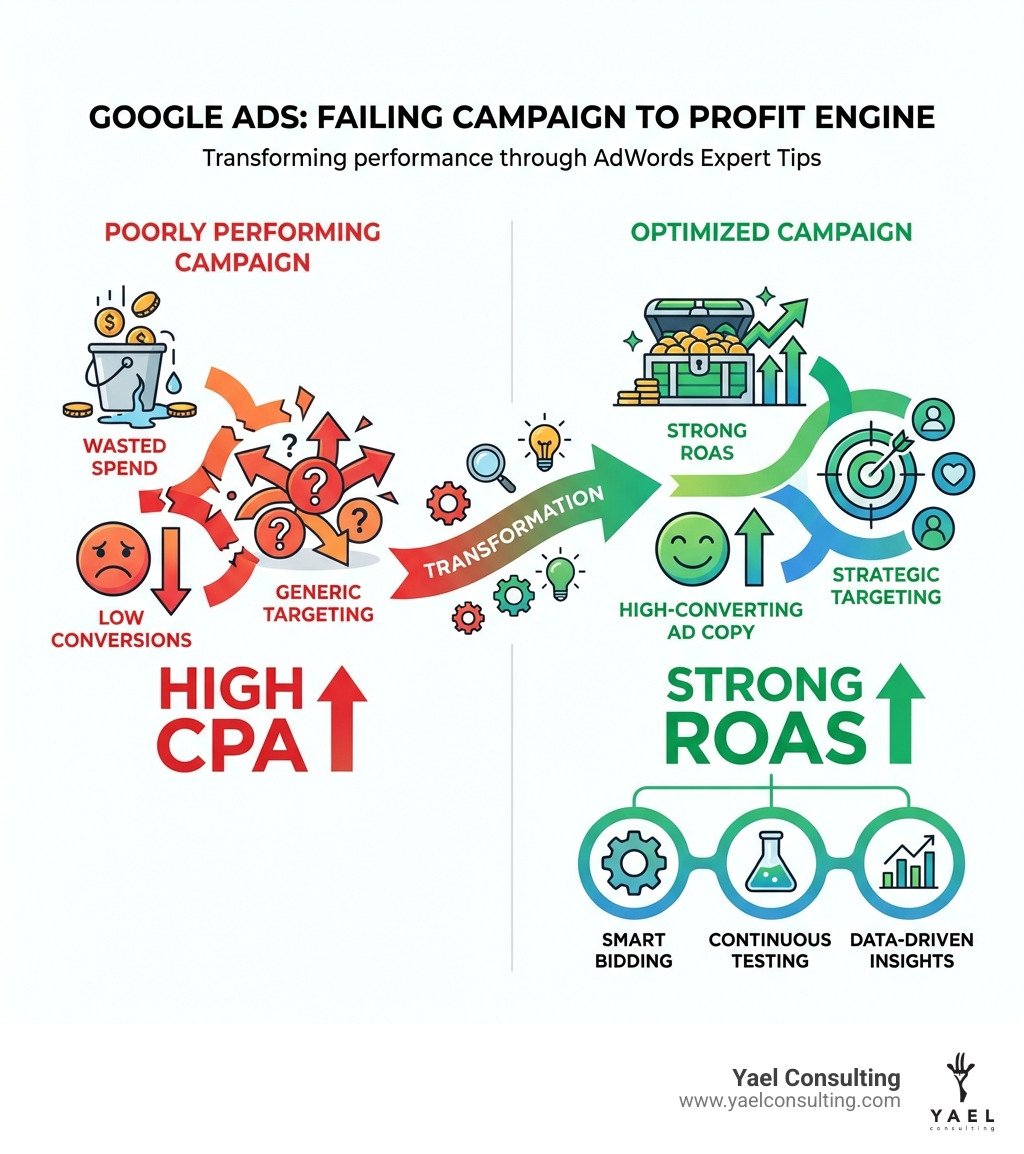
AdWords expert tips can transform a money-losing campaign into a profit engine, but most advertisers never learn them.
What separates the pros from everyone else:
- Focus on sales value and profitability, not just conversions
- Master Responsive Search Ads (RSAs) and Ad Strength
- Eliminate wasted spend with negative keywords and search term reports
- Improve relevance and Quality Score with tight keyword grouping
- Match intent to your offer and calls-to-action
- Use automation strategically, not blindly
- Test relentlessly across ads, landing pages, and audiences
Research shows that 41% of all search clicks go to the top three paid ad spots. Yet many small businesses waste a large share of their paid search budget on poor targeting, weak ad copy, and unoptimized campaigns.
The difference between a struggling campaign and a profitable one is not just more money, it’s smarter strategy. Launching a Google Ads campaign takes minutes. Achieving consistent profitability requires expertise in keyword research, ad copywriting, bidding strategies, and continuous optimization.
Common mistakes include bidding on keywords that never convert, writing generic ad copy that blends in with competitors, ignoring landing page optimization, or chasing vanity metrics like clicks and impressions instead of business results. Even worse, advertisers often treat Google Ads as a “set and forget” system when it requires ongoing testing and refinement.
I’m Lior Krolewicz, a former Special Operations commander who now runs a boutique Google Ads agency. Over 15 years, I’ve developed proprietary systems and adwords expert tips that have helped clients achieve dramatic productivity increases and significant margin growth.
The Foundation: Pre-Campaign Strategy & Setup
Before we even think about keywords or ad copy, the most crucial step is to lay a solid foundation. This means deeply understanding your business and setting clear, measurable goals. Jumping into Google Ads without a clear objective almost always leads to wasted spend and frustration.

We start by asking: what truly drives your business? What are your “go-buttons”? What motivates your target audience? Who are your ideal customers in the USA, Israel, New York, or Los Angeles? We consider all lead-driving factors, from your mode of operations to your overall business strategy.
Your Google Ads campaigns should align with these overarching business objectives, whether it’s brand awareness, lead generation, or direct sales. Goals are specific, measurable, achievable, relevant, and time-bound.
This initial phase also includes budget planning. We clarify how much you are willing to invest and what return you expect. Without this, optimization becomes guesswork.
Essential AdWords Expert Tips for Keyword Research
Keywords are the backbone of any successful Google Ads campaign. But it’s not enough to pick popular terms; we use keywords strategically to maximize performance.
We begin with keyword intent. Are people searching for information, or are they ready to buy? We prioritize high-intent keywords that signal purchase readiness. Think “buy organic coffee beans” versus “best coffee brands”. The former indicates a user ready to purchase, while the latter is still in the research phase.
Next, we target long-tail keywords. These are typically 3–5 words long and highly specific, often leading to better conversion rates because they capture a more defined user need. While they might have lower search volume, their specificity usually means less competition and higher relevance.
Competitor research is also vital. We use tools like Google’s Auction Insights report to see who we’re competing with and to analyze their keyword strategies. This helps uncover expansion opportunities and identify gaps in the market. Google Keyword Planner is our go-to for finding new keywords and understanding search volumes, and combining it with competitor insights gives us a significant edge.
Finally, we organize keywords into tight, relevant groups. We often employ Single Keyword Ad Groups (SKAGs) where each ad group focuses on one specific keyword. This allows for hyper-relevant ad copy and landing pages, which can improve Quality Score and reduce costs. We also group keywords by buying stage—Top of Funnel (awareness), Middle of Funnel (consideration), and Bottom of Funnel (purchase)—to tailor our messaging precisely.
Setting Up Tracking for Success
What gets measured gets managed. In Google Ads, accurate tracking is non-negotiable. We ensure that every campaign has robust conversion tracking in place from day one. This includes tracking lead forms, phone calls, purchases, and any other micro-conversions relevant to your business goals.
We set up conversion actions in Google Ads and often use Google Tag Manager for efficient implementation and management of tracking codes. Data accuracy is paramount; we regularly test our conversion tracking by submitting test leads to ensure every conversion is recorded exactly as expected. Signs of faulty tracking, like suddenly doubling conversions or discrepancies between Google Analytics and Google Ads, are red flags we address immediately.
Beyond basic online conversions, we also help businesses track offline conversions. For instance, if a Google Ad leads to a phone call that results in a sale weeks later, we ensure that connection is made. This holistic view of the customer journey allows us to optimize for true profitability, not just clicks or even online conversions. Google AI can connect and improve your web and app experience, driving an increase in your web campaign ROI when tracking is properly integrated. For more detailed guidance, Google provides an excellent resource on conversion tracking.
Crafting Ads That Convert: Copy, Creative & Landing Pages
Your ads are the voice of your products and services. The more relevant and engaging they are to your customers, the more likely they’ll generate results. But a strong ad is only half the battle; it must lead to an equally compelling landing page. The connection between your ad and its landing page is the bridge between a potential customer and a purchase.
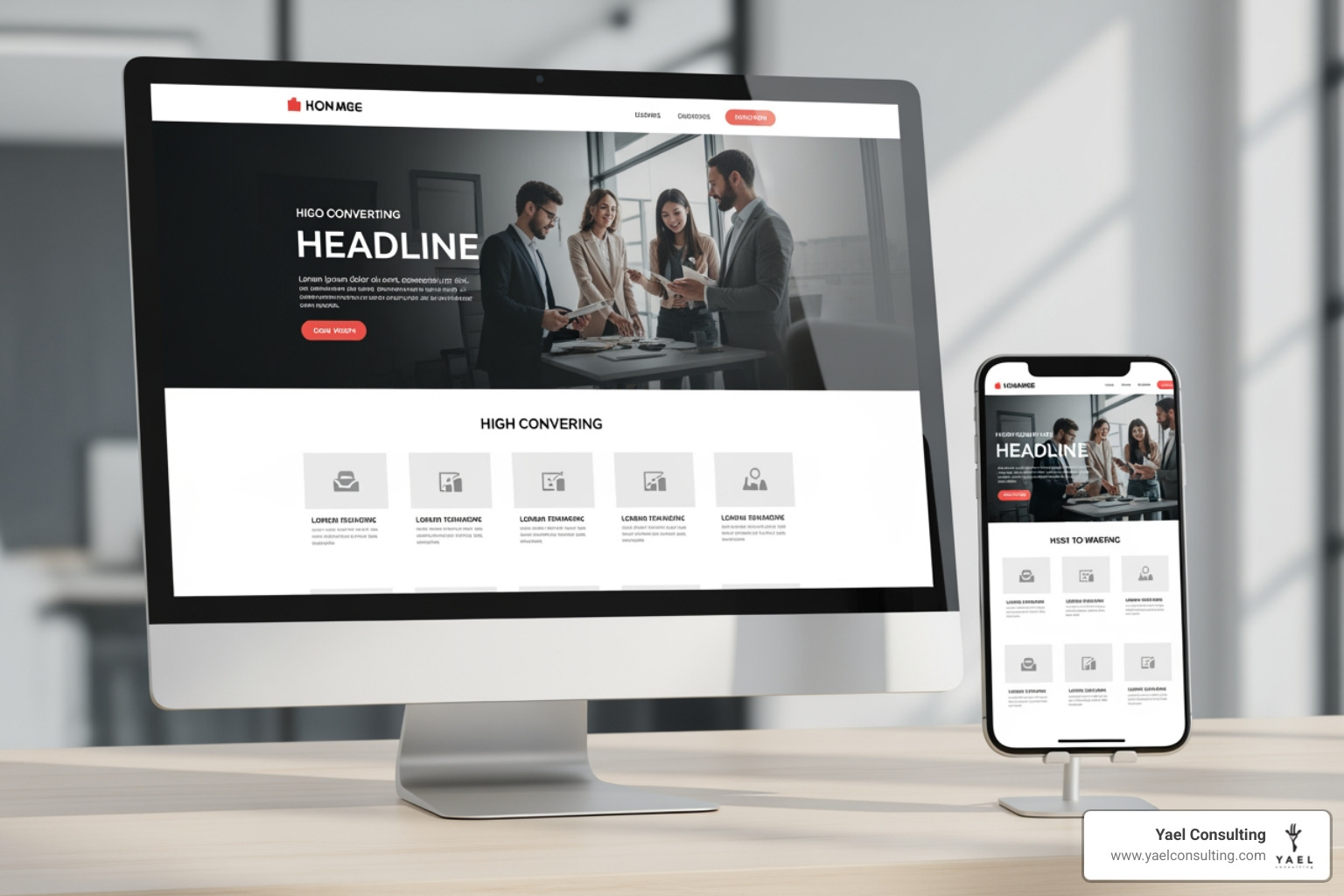
We optimize both ad copy and the landing page experience, focusing on message match, user experience (UX), and mobile-friendliness. This synergy directly impacts your Quality Score, which in turn affects your ad’s position and cost per click.
Writing Compelling Ad Copy That Stands Out
Creating ad copy that truly stands out requires a blend of art and science. We need to be concise, unique, relevant, believable, and solution-oriented. Due to strict character limits (for example, 30 characters for headlines and 90 for descriptions in RSAs), every word counts.
Here’s how we craft compelling ad copy:
- Be Concise: Use every character wisely, focusing on clarity and impact.
- Be Unique: Differentiate your ads from competitors. This might involve highlighting a unique selling proposition (USP), using symbols (like a registered trademark symbol), or incorporating numbers (for example, “500+ Happy Clients” or “20% Off Today!”). Research shows using local area codes in phone numbers can even lift conversion rates.
- Be Relevant: Your ad must directly answer the user’s search query. We tie headline and description messaging directly to keywords and user intent.
- Be Believable: Build trust by mentioning verifiable facts, certifications, or social proof such as “Trusted by thousands of businesses” or “15+ Years Experience”.
- Be the Solution: Position your business as the answer to the user’s problem. A simple formula is: Pain Point → Solution → Urgency → Call to Action. For instance, “Struggling with dull skin? Our serum hydrates in 24 hours. Limited time 20% off. Shop now.”
- Strong Call-to-Action (CTA): Always include a clear, specific CTA like “Get a Free Quote”, “Shop Now”, or “Call Us Today”.
While many marketers emphasize “benefits over features”, educated buyers also look for details. For them, dedicating space to product features as well as benefits can improve performance. Most people make their decision in the headline, so your most important message belongs there.
Mastering Responsive Search Ads (RSAs)
In June 2022, Expanded Text Ads (ETAs) were phased out, making Responsive Search Ads (RSAs) the standard. RSAs are Google’s largest and most flexible search ad format. Instead of writing fixed ads, we provide Google with up to 15 different headlines (30 characters each) and up to 4 different descriptions (90 characters each). Google’s AI then mixes and matches these assets to create the most effective ad for each search query, user, and context.
Google states that RSAs can have a higher CTR compared to standard search ads. The key to mastering RSAs is variety and quality. We aim for 8–10 unique headlines and at least 3 distinct descriptions per ad group. Each asset highlights something different, avoiding repetition. We include keywords in some headlines, but not all, and vary the lengths of both headlines and descriptions to give Google’s AI maximum flexibility.
A crucial metric here is Ad Strength. Advertisers who improve Ad Strength for their responsive search ads from “Poor” to “Excellent” see more conversions on average. We continuously monitor and improve Ad Strength by ensuring we provide enough unique, relevant assets.
While RSAs offer powerful automation, we use pinning sparingly. Pinning a headline or description to a specific position restricts Google’s ability to test combinations. We only pin when a legal disclaimer or a critical brand message absolutely must appear in a specific spot. We also leverage the combinations report to understand which asset combinations are performing best.
Leveraging Ad Assets and Landing Page Relevance
Ad assets (formerly known as ad extensions) are powerful tools that improve your ads, providing additional information and increasing their visibility. We leverage every relevant asset type to give your campaigns an extra push. These include:
- Sitelinks: Additional links to specific pages on your website.
- Image assets: Visuals of your products or services, which can boost conversions at a similar cost per conversion when paired with your business logo and name.
- Callouts: Short, non-clickable phrases highlighting unique benefits (for example, “Free Shipping”, “24/7 Support”).
- Promotions: Special offers like discounts or sales.
- Location assets: Showcasing your physical address, especially useful for businesses in New York or Los Angeles.
- Call assets: Displaying your phone number directly in the ad. Using local area codes can significantly improve response.
Beyond assets, landing page relevance is paramount. Your landing page must seamlessly continue the conversation started by your ad. If your ad promises “20% off shoes”, the landing page must immediately present shoes with a 20% discount. A mismatch will increase bounce rates, lower your Quality Score, and waste your ad spend.
We ensure:
- Consistent Messaging: The keywords and offers from your ad are clearly visible on the landing page.
- Fast Load Times: A slow-loading page is a conversion killer. We test site speed and optimize for quick delivery, especially on mobile devices.
- Clear CTA on Page: The desired action is obvious and easy to complete, mirroring the ad’s call to action.
- Mobile-Friendliness: With many customers browsing on mobile, your landing page must be responsive, easy to steer, and quick to contact you.
Smart Bidding & Budgeting: AdWords Expert Tips for ROI
The goal of Google Ads is not just clicks; it’s profitable actions. This means optimizing your campaigns based on Cost Per Action (CPA) and Return On Ad Spend (ROAS), not just Cost Per Click (CPC). A low CPC is meaningless if those clicks don’t convert into leads or sales. We focus on getting you more leads or sales at a sustainable cost, ensuring every dollar spent contributes to your bottom line.
Budget allocation is a dynamic process. We monitor campaign performance and allocate more budget to the campaigns, ad groups, and keywords that deliver the highest ROI, while reducing spend on underperforming areas.
Choosing the Right Bidding Strategy
Google Ads offers a variety of bidding strategies, and choosing the right one depends entirely on your campaign goals. Here’s a quick comparison of common strategies:
| Strategy | Goal Focus | Control Level | Automation Level | Best Use Case |
|---|---|---|---|---|
| Manual CPC | Clicks | High | Low | High-control campaigns, very specific niches, testing bids |
| Improved CPC | Conversions | Medium | Medium | Manual control with smart adjustments for conversions |
| Target CPA | Maximize conversions at target cost | Low | High | When you have a clear CPA goal for leads or sales |
| Target ROAS | Maximize conversion value at target ROAS | Low | High | E-commerce, when revenue or value per conversion is tracked |
| Maximize Clicks | Maximize clicks within budget | Low | High | Brand awareness, driving traffic to a new page |
| Maximize Conversions | Maximize conversions within budget | Low | High | When conversions are the primary goal, regardless of CPA |
| Performance Max | Maximize conversions or value across all Google channels | Very Low | Very High | Holistic goal-driven campaigns, leveraging AI across channels |
We often leverage Google’s Smart Bidding strategies, which use machine learning to optimize bids in real time for conversions or conversion value. For e-commerce businesses, Target ROAS is often a powerful tool, automatically adjusting bids to achieve your desired return on ad spend. For lead generation, Target CPA can be highly effective. Performance Max campaigns, while offering less direct control, can be powerful for maximizing conversions across all Google channels by leveraging Google’s AI. Our expertise lies in selecting and fine-tuning these strategies to align with your profitability objectives.
Key Metrics to Measure (Beyond Clicks and CTR)
While Click-Through Rate (CTR) is useful for gauging ad relevance and initial engagement (and a good CTR supports Quality Score), we look far beyond it to understand campaign success. The aim of any Google Ads campaign is to generate leads or increase sales, so our focus is on business-level outcomes.
Key metrics include:
- Conversion Rate (CVR): The percentage of clicks that result in a desired action (for example, a purchase or a lead form submission).
- Cost Per Action (CPA) / Cost Per Conversion: The average cost you pay for each conversion.
- Return On Ad Spend (ROAS): The revenue generated for every dollar spent on advertising.
- Customer Acquisition Cost (CAC): The total cost to acquire a new customer.
- Customer Lifetime Value (LTV): The predicted revenue that a customer will generate throughout their relationship with your business.
- Impression Share: The percentage of times your ads were shown compared to the total number of impressions they could have received.
We avoid focusing on “vanity metrics” like clicks and impressions when they don’t correlate with these core business outcomes. We measure what ultimately drives your sales and profit.
Advanced Optimization & Scaling Tactics
Google Ads is not a “set and forget” system. It demands continuous optimization, testing, and strategic budget allocation. What worked last month may not be effective today due to evolving trends and customer preferences. Continuous improvement and data-driven decisions are at the heart of our adwords expert tips.
We accept A/B testing, experimenting with different ad versions, landing pages, and targeting strategies to constantly improve performance. This iterative process allows us to scale winning campaigns and expand your audience profitably.
The Power of Negative Keywords and Remarketing
Two of the most powerful adwords expert tips for optimizing spend and improving ROI are negative keywords and remarketing.
Negative Keywords: Businesses can lose a significant portion of their budget on irrelevant searches. Negative keywords tell Google not to show your ad for specific search terms. For example, if you sell “luxury watches”, you might add “cheap” or “replica” as negative keywords to avoid showing your ad to users looking for low-cost or counterfeit items. We implement negative keywords at both the campaign level (for broad exclusions) and the ad group level (for granular control within specific themes). Regularly reviewing the Search Terms report is crucial; we identify terms that are generating clicks but no conversions and add them as exact match negative keywords.
Remarketing (Retargeting): This strategy allows you to re-engage users who have previously interacted with your website or app. Remarketing Lists for Search Ads (RLSA) are particularly powerful. We can layer these audiences onto your search campaigns, allowing us to bid more aggressively on competitor keywords for users who have already visited your site. This is highly effective for users nearing a purchase decision, as they’re familiar with your brand but might be comparing options.
AdWords Expert Tips for Continuous Optimization and Scaling
Beyond negative keywords and remarketing, continuous optimization involves a variety of tactics:
- Ad Variations & Testing: We test different ad variations, experimenting with headlines, descriptions, CTAs, and unique selling points. Google’s Experiments page is a valuable tool for testing changes before rolling them out widely.
- Bid Adjustments: We fine-tune bids based on performance across different dimensions:
- Device: Mobile, desktop, and tablet performance can vary significantly.
- Location: We increase bids for high-performing geographic areas (for example, specific neighborhoods in Los Angeles or New York) and decrease or exclude underperforming ones.
- Time of Day/Day of Week: We analyze when your audience is most likely to convert and adjust ad schedules and bids accordingly.
- Audience: We adjust bids for specific audience segments, including remarketing lists, in-market segments, and demographic groups.
- Exploring New Campaign Types: Once core campaigns are optimized, we explore new avenues for scaling, such as Video Ads for awareness, Shopping Ads for e-commerce, or Performance Max campaigns to leverage Google’s AI across channels.
- Lookalike Audiences: We use your existing customer data to find new users who share similar characteristics, expanding your reach to highly qualified prospects.
- Automation: We use automation rules and Smart Bidding to manage bids and budgets efficiently, freeing up time for strategic analysis and creative development.
Frequently Asked Questions about Google Ads
How often should I optimize my Google Ads campaigns?
Google Ads is not a “set and forget” platform; it requires ongoing attention. A structured approach helps:
- Daily Checks: Briefly monitor for performance fluctuations, budget pacing issues, and ad disapprovals.
- Weekly to Bi-Weekly: Review Search Term Reports to add negative keywords and identify new opportunities. Revisit bid adjustments for locations, devices, and audiences.
- Monthly Deep-Dives: Evaluate new ad tests, review geolocation strategy, analyze dayparting data, and assess demographic performance. Retire underperforming campaigns or restructure ad groups when needed.
- Quarterly Reviews: Conduct a comprehensive review of strategy, budget allocation, and long-term goals.
It typically takes several weeks to gather enough data for meaningful optimizations, but consistent, smaller adjustments are key to pushing performance in the right direction.
What are the most important metrics for Google Ads success?
While Click-Through Rate (CTR) is important for ad relevance and Quality Score, we look beyond it to measure business success. The most important metrics are those that directly tie back to your profitability:
- Conversion Rate: The percentage of ad interactions that lead to a valuable action.
- Cost Per Action (CPA) / Cost Per Conversion: How much you’re paying for each lead or sale.
- Return On Ad Spend (ROAS): The revenue generated for every dollar spent on ads.
- Customer Acquisition Cost (CAC) and Lifetime Value (LTV): Understanding these helps ensure long-term profitability.
We avoid focusing on “vanity metrics” like impressions and raw clicks when they don’t correlate with these core business outcomes.
When should I hire a Google Ads expert?
You should consider hiring a Google Ads expert or agency if you’re experiencing:
- Wasted Ad Spend: A significant portion of your budget is going to irrelevant clicks or keywords that don’t convert.
- Lack of Time: Managing Google Ads effectively is time-consuming and requires consistent attention.
- Complex Accounts: As campaigns grow, they become more complex with multiple ad groups, keywords, bidding strategies, and assets.
- Falling Behind Competitors: If competitors are outperforming you, an expert can analyze their strategies and help you gain an edge.
- Desire to Scale Profitably: You want to grow through Google Ads but need a proven strategy to ensure that growth is profitable.
- Struggling with Profitability: Your campaigns aren’t generating a positive ROI, and you need help diagnosing and fixing the issues.
Launching a Google Ads campaign is easy. Achieving consistent, profitable results is difficult. An expert understands your business, tracks everything, tests continuously, actively manages your account, and focuses on outcomes like sales and profitability.
Take Your Campaigns to the Next Level
Mastering Google Ads requires a combination of strategic planning, compelling creative, smart bidding, and continuous optimization. It is a dynamic and complex platform, but with the right approach, it can become a powerful engine for your business growth.
We’ve shared our top adwords expert tips to help you build a solid foundation, craft ads that convert, optimize your spending for maximum ROI, and scale your campaigns effectively. From meticulous keyword research and robust tracking to the nuances of Responsive Search Ads, powerful ad assets, and data-driven bidding strategies, every element plays a role.
If you’re ready to stop guessing and start seeing real results, Yael Consulting can help. Yael Consulting is a boutique Google Ads agency with 15+ years of expertise. We specialize in driving significant sales and profit growth for e-commerce and lead generation businesses through one-client-per-market exclusivity, proprietary technology, and direct CEO involvement. Our USP is offering a free, actionable 15-minute Google Ads analysis with guaranteed value.
Get your free, expert Google Ads analysis and see what the pros know.


Ex Special-Ops commander turned Google Ads expert and online marketing consultant. In minutes I will show you exactly how I will improve your profits (no fluff), backed by a 30-day guarantee. Feel free to contact me.
Lior is an expert in online marketing, strategy, operations, and technology. In his experience with diverse industries, military, and small and fortune-500 companies, he personally increased sales and productivity, built reporting platforms, and cut wasteful costs, all to ultimately hit company goals.
Lior has passion for learning, curiosity, and genuine commitment to get results. He enjoys working with high-performance and results-driven teams and performs best in environments that strive for excellence.
Specialties: Search Engine Marketing (SEM, PPC, Paid Search), Google Adwords, Bing-Yahoo Marketing, Landing Page Optimization. Data, ROI, and LTV Analytics, Report and Process Automation.