

Why a Macro Environment Audit Is the Foundation of Smart Business Strategy
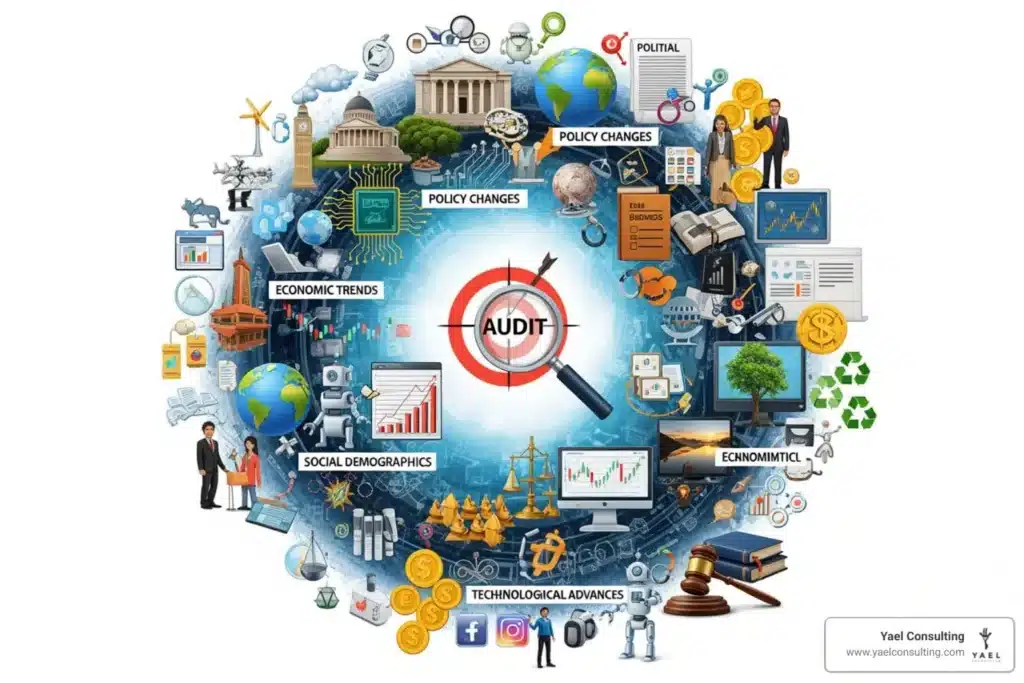
A macro environment audit is a structured review of the external forces that shape your business, forces you can’t control, but absolutely must plan for.
Here’s a quick breakdown of what it covers:
| PESTLE Factor | What It Examines |
|---|---|
| Political | Government policy, trade agreements, tax laws |
| Economic | GDP, inflation, interest rates, consumer spending |
| Social | Demographics, lifestyle trends, cultural shifts |
| Technological | AI adoption, R&D, patent activity, infrastructure |
| Legal | Regulations, labor laws, compliance requirements |
| Environmental | Climate change, sustainability, natural forces |
These six factors form the backbone of any macro audit, and ignoring even one of them can leave your strategy exposed.
Think about it this way: business stability depends on your ability to spot and respond to change before it hits you. Markets mutate. Consumer behavior shifts. Regulations tighten. The businesses that survive, and grow, are the ones that see it coming.
That’s exactly why a macro environment audit isn’t a one-time exercise. It’s an ongoing strategic habit.
I’m Lior Krolewicz, a former Special-Ops commander turned strategic marketing consultant, and I’ve applied the same systematic, no-variable-missed thinking from the battlefield to helping businesses use a macro environment audit to stop wasting ad spend and find real growth leverage. In the sections ahead, I’ll walk you through exactly how to do it.

Defining the Macro Environment Audit and Its Importance
At its core, a macro environment audit is an exhaustive examination of the “big picture” forces that influence an entire economy or industry. Unlike your internal operations, these forces are largely uncontrollable. You can’t stop the Federal Reserve from raising interest rates, and you can’t prevent a new privacy law from being passed. However, you can audit these factors to ensure your business cycle remains healthy.
In strategic management, this audit serves as a high-level scanning tool. It helps us identify high-level opportunities (like a sudden surge in consumer spending) and mitigate hazards (like a looming recession or a disruptive new technology). By zooming out, we gain the clarity needed to make operational decisions that are proactive rather than reactive.
Why Every Business Needs a Macro Audit
In business, change is the only constant. The impact of macro-environmental factors on business performance is profound; it can literally mean the difference between survival and extinction. A business that fails to account for market mutations—such as the shift toward mobile-first shopping or the rise of AI—will quickly find itself obsolete.
Conducting a macro environment audit allows us to:
- Ensure Long-term Survival: By anticipating external shocks before they cripple our cash flow.
- Improve Competitive Positioning: By identifying gaps in the market that competitors have missed.
- Optimize Resource Allocation: Ensuring we aren’t pouring money into a “dying” demographic or a technologically stagnant channel.
Distinguishing Between Micro and Macro Environments
It’s easy to get these two confused, but they require very different analytical lenses. The micro-environment consists of factors close to the company that affect its ability to serve its customers. This includes your suppliers, your direct competitors, and your specific customer base.
The macro-environment, however, deals with aggregate production, spending, and price levels across the broader economy. To help visualize the difference, we’ve put together this comparison:
| Feature | Micro Environment | Macro Environment |
|---|---|---|
| Scope | Small, specific, and immediate | Broad, general, and external |
| Control | Some level of influence (e.g., negotiating with suppliers) | Little to no control (e.g., national inflation) |
| Key Actors | Customers, Competitors, Resellers, General Public | Political, Economic, Social, Tech, Legal, Environmental |
| Analysis Tool | SWOT, Porter’s Five Forces | PESTLE, Scenario Planning |
The PESTLE Framework: Key Components of a Macro Audit

To perform a thorough macro environment audit, we use the PESTLE framework. This ensures we don’t miss any critical external “blind spots.”
Political and Legal Factors in a Macro Environment Audit
Political factors involve the level of government intervention in the economy. This includes tax policies, trade agreements, and general political stability. For businesses operating in the USA or Israel, understanding the current administration’s stance on international trade or tech regulation is vital.
How to Conduct a PEST Analysis often starts with looking at regulatory trends. Are labor laws becoming more stringent? Is there a push for deregulation in your specific sector? Legal factors often overlap with political ones, focusing on specific legislation like consumer protection laws, health and safety regulations, and antitrust laws. For instance, Google’s mandatory switch to HTTPS in 2018 was a technical requirement driven by a broader legal and social push for data security.
Economic and Social Forces Shaping Strategy
Economic health is perhaps the most direct influencer of business performance. We look at indicators such as GDP growth, interest rates, and inflation. For example, the Federal Reserve generally targets an annual inflation rate of 2%. When inflation rises above this, consumer spending patterns shift. In the second quarter of 2021, consumer spending made up a massive 54% of the U.S. GDP; any dip in that number ripples through every e-commerce business.
Social forces are equally powerful. We must track changes in living standards and social forces such as demographics, lifestyle shifts, and buying patterns. Are people moving out of major hubs like New York or Los Angeles? Is there a growing cultural trend toward “green” lifestyles? These social shifts dictate what people buy and how they want to be marketed to.
Technological and Environmental Considerations
Technological change is the fastest-moving part of the macro environment audit. We monitor R&D budgets, patent activity, and the pace of AI adoption. It’s not just about the “final product”; it’s about how technology changes communication, human resource attraction, and marketing methods. If your telecommunications infrastructure or bandwidth capacity isn’t up to par, you’re already behind.
Environmental factors have moved from the “nice to have” category to a core strategic pillar. Sustainability, climate change, and carbon footprint regulations are now major considerations for modern organizations. Whether it’s adapting to extreme weather patterns or meeting new “green” compliance standards, the environment is a force that can no longer be ignored.
Tools and Frameworks for Conducting a Macro Analysis
While PESTLE is the gold standard, we often combine it with other tools to get a 360-degree view.
- SWOT Analysis: While SWOT is often internal, PESTLE insights feed directly into the “Opportunities” and “Threats” sections of your SWOT.
- Porter’s Five Forces: This helps us understand the competitive intensity and attractiveness of an industry by looking at supplier power, buyer power, and the threat of substitutes.
- Scenario Planning: This is like crafting a “business adventure story.” We imagine multiple paths based on different macro-environmental shifts—what happens if interest rates double? What if a new competitor enters the market with a breakthrough AI tool?
- Critical Success Factors (CSF): We identify the few key areas where things must go right for the business to flourish.
What is a PESTLE Analysis? It is essentially a roadmap that helps you navigate these frameworks without getting lost in the data.
Integrating Macro Insights into Your Audit
Data is useless if it doesn’t lead to action. We believe in the ultimate guide to Google Ads analysis because it shows how external data (like search trends and economic shifts) should dictate your actual ad spend. Cross-functional collaboration is key here. Your marketing team needs to talk to your finance team to understand how macro-economic trends will impact the quarterly budget.
Real-World Application: The Amazon Case Study
Amazon is a masterclass in responding to the macro environment. They didn’t just “get lucky”; they audited the world around them and moved first.
- Technological: They invested heavily in ICT and Service Oriented Architecture (SOA) to monitor performance in real-time.
- Social/Cultural: They recognized the shift toward “green” living and secure online shopping, building a platform that prioritized trust and efficiency.
- Economic: They leveraged global demand for discounts and fast shipping, scaling their infrastructure to meet the needs of every demographic.
Step-by-Step Process for Performing an Effective Audit
Ready to start? Follow this 8-step process to ensure your macro environment audit is effective and actionable.
- Objective Setting: What are you trying to achieve? Are you entering a new market or just trying to stop wasting ad spend?
- Data Gathering: Use reliable sources. Look at government reports, think tanks, industry associations, and news organizations.
- Identify Key Factors: Not every PESTLE factor matters equally to every business. Spot the ones that move the needle for you.
- Trend Analysis: Look for connections. How does a political shift in trade policy impact economic inflation in your sector?
- Identify Opportunities and Threats: Use your findings to build the external half of your SWOT matrix.
- Weigh Risks: Assess the likelihood and potential impact of each threat.
- Imagine Scenarios: Develop “What If” plans for the most likely macro shifts.
- Actionable Strategy: Turn your insights into a strategic roadmap with clear deadlines and owners.
Identifying Opportunities and Threats
A good audit helps you navigate industry uncertainty. For example, if you see a technological gap in your competitors’ mobile offerings, that’s an opportunity. If you see an “external shock” like a sudden regulatory change in New York regarding data privacy, that’s a threat. Building a resilience mindset means preparing for these before they become emergencies.
Turning Insights into Actionable Business Strategies
Strategy is about resource allocation. If your macro environment audit shows that your target demographic is moving toward a specific social trend, you shift your marketing budget there. This is where how to audit your Google Ads account comes into play—you don’t just set it and forget it; you adjust based on the world around you.
We often use Contingency Theory, which suggests that there is no “one best way” to lead a company. Instead, the optimal course of action is contingent (dependent) upon the internal and external situation.
Frequently Asked Questions about Macro Audits
How often should a company conduct a macro environment audit?
We recommend a deep-dive audit at least once a year, with smaller “pulse checks” every quarter. Given that a website’s average “shelf life” is only 1.5 to 2.5 years, you need to stay updated on technological and search trends constantly to remain competitive. If the market is particularly volatile (like during a global pandemic or a period of high inflation), you might need to audit even more frequently.
What are the common challenges in macro environment analysis?
The biggest hurdle is often analysis paralysis. There is an infinite amount of data out there, and it’s easy to get bogged down in “researching” without ever “acting.” Other challenges include:
- Data Reliability: Not all sources are created equal. Stick to verified industry and government data.
- Rapid Change: By the time you finish a 6-month audit, the world might have changed. Speed is essential.
- Overcoming Biases: Don’t just look for data that confirms what you already believe.
How do macro factors impact developing economies?
While we focus on the USA and Israel, it’s worth noting how macro factors create extreme volatility in developing regions. For example, businesses often face unreliable infrastructure, high operating costs, and massive exchange rate fluctuations. These “unnecessary constraints” make a macro environment audit even more critical for survival in those markets, as the margin for error is much thinner.
Conclusion
Mastering the macro environment audit isn’t just about collecting data; it’s about building a resilience mindset. It’s about looking at the global landscape and saying, “I see where this is going, and we’re going to be ready.”
At Yael Consulting, we live and breathe this kind of strategic analysis. We don’t just manage ads; we look at the macro forces driving your business to ensure every dollar you spend is an investment in growth. If you’re ready to see how these external forces are impacting your bottom line, we’re here to help.
Start with a free PPC analysis, it’s your first step to a smarter, more resilient campaign. Let’s master your Google Ads management together and turn those macro insights into measurable profit.