

Why AdWords Smart Bidding Is Changing How Advertisers Win on Google
AdWords Smart Bidding is Google’s AI-powered system that automatically sets the right bid for every single auction, in real time, to maximize your conversions or conversion value.
Quick answer: What is AdWords Smart Bidding?
- It’s a set of automated bid strategies inside Google Ads
- It uses machine learning to optimize bids at the moment of each auction
- It factors in signals like device, location, time of day, and user behavior
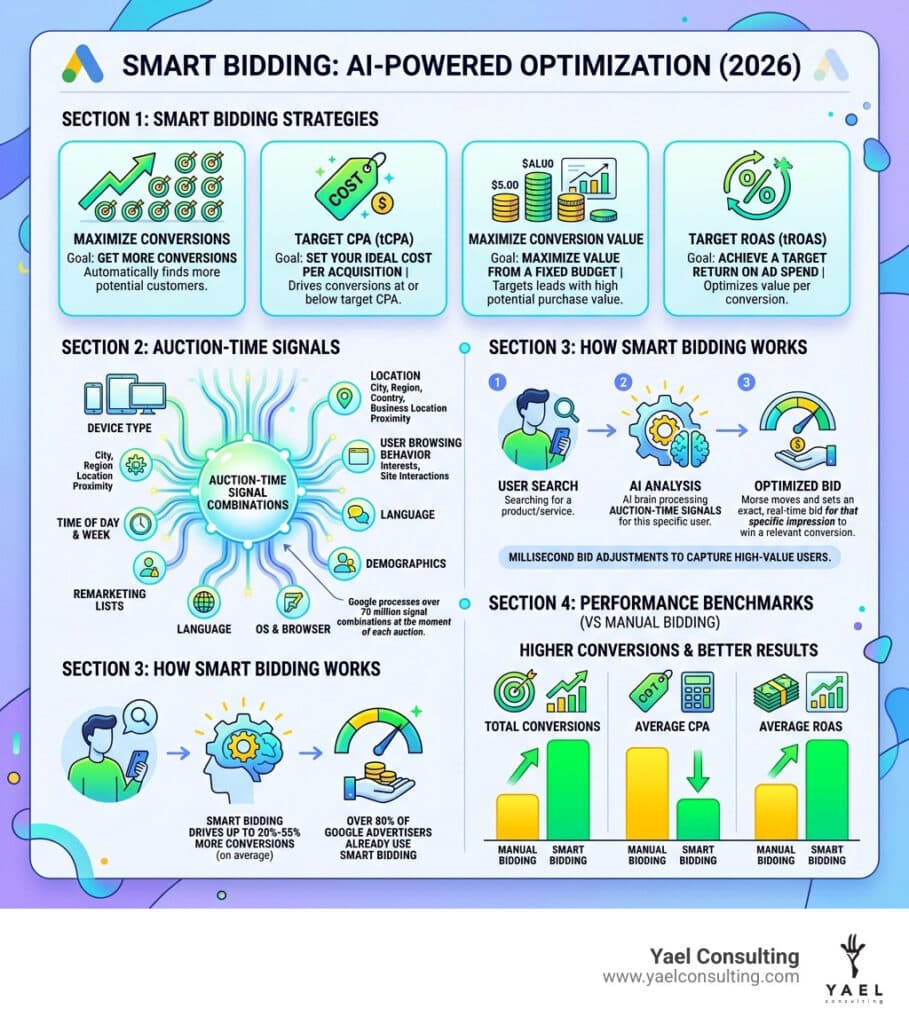
- The four main strategies are: Maximize Conversions, Target CPA, Maximize Conversion Value, and Target ROAS
- Over 80% of Google advertisers already use it
If you’re still setting bids manually, you’re making one bid decision at a time. Smart Bidding makes millions of decisions per day, and it has access to data you simply can’t see.
Think about it this way: Google processes over 70 million signal combinations for a single auction. No human, no spreadsheet, and no manual bid adjustment can compete with that.
The results back it up. Target CPA delivers around 20% more conversions than manual bidding. Maximize Conversions can drive up to 55% more. Real businesses have seen dramatic gains, a travel company earned 57% more profit after switching from their own bidding solution to Smart Bidding.
But Smart Bidding isn’t a magic switch. It works best when set up correctly, with clean conversion tracking and enough data to learn from. That’s exactly what this guide covers.
I’m Lior Krolewicz, a former Special Ops commander turned Google Ads expert, with over 15 years of experience managing millions in ad spend and helping businesses scale profitably using strategies like AdWords Smart Bidding. I’ve seen, across hundreds of accounts, when automated bidding crushes it, and when it quietly drains your budget without you noticing. Let me show you how to make it work for you.
What is AdWords Smart Bidding?
At its core, adwords smart bidding is a subset of automated bidding strategies that use Google’s machine learning to optimize for conversions or conversion value. While “automated bidding” is a broad umbrella that includes things like maximizing clicks, “Smart Bidding” specifically refers to strategies that focus on the bottom line: leads and sales.
The “secret sauce” here is something called auction-time bidding. In the old days (and by old, we mean a few years ago), you might set a bid of $2.00 for a keyword. That bid stayed $2.00 until you manually changed it. With Smart Bidding, Google looks at every single person searching for your keyword and asks: “Based on everything we know about this user, how likely are they to buy?”
If the user is on a high-end iPhone, sitting in a high-income zip code, and has visited your site three times in the last week, the algorithm might bid $10.00 to make sure you show up. If the user is on a 10-year-old desktop at 3:00 AM and has never shown interest in your product, it might bid $0.10. This real-time optimization happens in milliseconds, 40,000 times every second across the Google network.
We’ve found that for most of our clients, moving toward these AI-driven models is no longer optional—it’s a requirement to stay competitive. You can learn more about how this fits into the basics of bidding in a new account to see where you should start.
How it Differs from Manual Bidding
The difference between manual bidding and adwords smart bidding is like the difference between a map and a real-time GPS.
With manual bidding, you have “granular control.” You decide exactly what you want to pay for a click. You use bid modifiers to tell Google, “I want to pay 20% more for people on mobile” or “30% less for people in New York.” But these are blunt instruments. You are applying a broad rule to thousands of different people.
Smart Bidding, on the other hand, uses “AI precision.” It doesn’t just look at “mobile users in New York.” It looks at the interaction between signals. Maybe mobile users in New York convert great on Monday mornings but terrible on Friday nights. Manual bidding struggles to account for that level of complexity, whereas the AI thrives on it.
| Feature | Manual Bidding | Smart Bidding |
|---|---|---|
| Control | Full keyword-level control | Goal-based control (CPA/ROAS) |
| Data Usage | Limited to what you can see | 70 million+ signal permutations |
| Speed | Periodic updates | Real-time (Auction-time) |
| Efficiency | High time commitment | Set and monitor |
| Optimization | Static rules | Adaptive learning |
The Evolution of AdWords Smart Bidding
Google’s bidding technology has come a long way. We used to rely heavily on Enhanced CPC (ECPC), which was a “halfway” house between manual and automated. It would take your manual bid and raise it slightly if a conversion seemed likely. However, Google is moving away from these hybrid models.
Effective the week of March 31, 2025, Enhanced CPC is being deprecated for Search and Display campaigns. This marks a total shift toward full machine learning. The algorithm no longer needs a manual “anchor” bid; it uses historical data and predictive modeling to determine the value of a click from scratch. This advanced bidding technique is now the standard for any advertiser looking to scale.
Core Strategies for Automated Success
Choosing the right adwords smart bidding strategy depends entirely on your business goals. Google provides several “flavors” of AI bidding, and picking the wrong one is a common mistake that can lead to wasted spend.

Maximizing Volume with AdWords Smart Bidding
If your primary goal is to get as many leads or sales as possible within a specific budget, you’re looking at volume-based strategies.
- Maximize Conversions: This strategy tells Google to spend your entire daily budget to get the most conversions possible. It’s great for clearing out inventory or when you have a set budget you must spend. However, be careful—without a “Target CPA” attached to it, Google might pay very high prices for clicks just to spend your money.
- Target CPA (tCPA): This is the “Gold Standard” for lead generation. You tell Google, “I want leads, and I’m willing to pay $50 per lead.” The AI then finds the auctions where it can hit that target. Research shows tCPA can deliver 20% more conversions than manual bidding.
For many, understanding rule-based bidding is the first step toward trusting these automated systems.
Optimizing for Value and ROI
For e-commerce businesses, not all conversions are equal. A $10 pair of socks is not the same as a $500 suit. This is where value-based bidding comes in.
- Maximize Conversion Value: Similar to maximizing conversions, but it focuses on the total dollar amount. It will prioritize a single $500 sale over five $10 sales.
- Target ROAS (tROAS): This is the most advanced strategy. You set a target Return on Ad Spend (e.g., 400%). Google will then bid to ensure that for every $1 you spend, you get $4 back in revenue. It’s been shown to deliver 30% more conversion value on average.
Choosing between CPA, CPC, and CPM is a foundational skill, but for modern e-commerce, ROAS is almost always the winner.
The 70 Million Signals Behind the Bid
Why is the robot better than you? Because it sees things you can’t. When Google calculates a bid, it evaluates over 70 million permutations of signals.
These signals include:
- Device & OS: Is the user on the latest iPhone or a budget Android tablet?
- Location Intent: Is the user in Los Angeles, or just searching about Los Angeles?
- Time of Day & Week: Is it a Thursday night (high intent for weekend reservations) or a Monday morning?
- Remarketing Lists: Has this user added something to their cart in the last 24 hours?
- Search Query Text: Are they searching for “leather boots” (high intent) or “how to repair boots” (low intent)?
- Browser & Language: What are their settings telling us about their demographics?
Google’s official help documentation emphasizes that these signals interact. A specific browser might convert better on a specific device at a specific time. No human can manage those millions of “if/then” scenarios.
Adaptive Learning and Query-Level Modeling
One of the coolest parts of adwords smart bidding is how it handles “data scarcity.” If you have a low-volume keyword that only gets 5 clicks a month, a human would have no idea how to bid on it.
Google’s AI uses adaptive learning. It looks at how that keyword performs across your entire account and even across other similar advertisers. It uses “query-level modeling” to predict performance even if that specific keyword hasn’t converted yet. It also accounts for conversion delay—the time it takes for someone to click an ad and finally buy. If your customers usually take 7 days to decide, the AI knows not to panic if it doesn’t see a sale on day one.
For more on these technical nuances, check out our part 2 guide on advanced bidding.
Best Practices for Campaign Implementation
Ready to let the robots take the wheel? Don’t just flip the switch and walk away. Follow these best practices to ensure a smooth takeoff.
- Fix Your Tracking: Smart Bidding is only as good as the data you give it. If your conversion tracking is broken, you are teaching the AI to chase the wrong goals.
- Use Data-Driven Attribution (DDA): Move away from “Last Click” attribution. DDA gives the AI a better picture of the entire customer journey.
- Pair with Broad Match: Smart Bidding and Broad Match are like peanut butter and jelly. Broad match finds the traffic, and Smart Bidding ensures you only pay for the clicks that matter.
- Portfolio Strategies: If you have multiple campaigns with the same goal, group them into a Portfolio Bid Strategy. This pools the data so the AI learns faster.
Transitioning from Manual to AdWords Smart Bidding
If you are currently using manual bidding, don’t go “cold turkey” on your whole account at once.
- Step 1: Identify a campaign with at least 30 conversions in the last 30 days.
- Step 2: Use the “Drafts & Experiments” tool to run a 50/50 split test.
- Step 3: Set your initial Target CPA or ROAS based on your actual performance over the last 30 days. Don’t set a “dream” target; set a realistic one.
- Step 4: Give it time. The learning period usually lasts 1–2 weeks. During this time, performance will fluctuate. Resist the urge to change anything!
- Step 5: Follow the 20% rule. Once the strategy is stable, only change your targets by +/- 20% per week to avoid re-triggering the learning phase.
Managing and Monitoring Performance
Just because the bidding is automated doesn’t mean the management is. You need to monitor the Bid Strategy Report. This report tells you if your strategy is “Limited by Budget” or if it’s still in the “Learning” phase.
Watch out for “statistical noise.” Don’t judge a strategy based on one bad day. Look at 7-day or 30-day windows. We’ve seen that Smart Display tools can be incredibly powerful, but they require a “watchman” to ensure the AI doesn’t go off the rails.
Frequently Asked Questions about Smart Bidding
How many conversions do I need for Smart Bidding to work?
While Google says you can start with zero, the reality is that the AI needs data. A good rule of thumb is at least 30 conversions in a 30-day window. For Target ROAS, Google recommends at least 50 conversions in 30 days. If you have less than that, the AI might struggle to find patterns, and your performance could be volatile.
How long is the learning period for new strategies?
Typically, it takes 1 to 2 weeks. During this time, Google is testing different bid levels and signals. You might see your CPCs spike or your volume drop. This is normal calibration. If you change your budget or target significantly during this time, the clock resets. Patience is your best friend here.
Is Smart Bidding better than manual bidding for small budgets?
It can be, but it’s tricky. If you have a tiny budget and very few conversions, the AI doesn’t have enough data to learn. In these cases, we often recommend bidding toward micro-conversions. Instead of bidding for a “Sale,” bid for “Add to Cart” or “Stayed on site for 2 minutes.” This gives the AI more data points to work with.
Conclusion
The era of clicking buttons to change bids by five cents is over. AdWords Smart Bidding has proven that machine learning can out-calculate and out-optimize even the most diligent human advertiser. With over 80% of advertisers already using automation, the question isn’t if you should use it, but how you can use it better than your competitors.
At Yael Consulting, we don’t just “set it and forget it.” We combine our 15+ years of boutique agency expertise with these powerful AI tools to ensure your campaigns aren’t just spending money—they’re generating profit. We offer a one-client-per-market exclusivity, meaning we aren’t helping your competitors while we help you.
Ready to see what the robots can do for your bottom line?
Stop guessing and start scaling. We offer a free, actionable 15-minute Google Ads analysis with a guaranteed value. We’ll look under the hood of your account and tell you exactly where Smart Bidding could be making you more money.
Get expert AdWords management services and your free analysis here